
Recovery Taking Hold as Rates Ease
NORMALIZATION OF AN UNCERTAIN WORLD
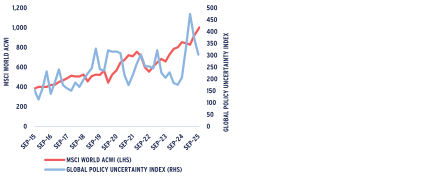
By Q3, markets showed less volatility compared to earlier in the year. Investors seemed to have priced in recurring trade frictions and paid little heed to geopolitical shocks. Uncertainty is now considered a constant, requiring active investors to cut through the noise and stay focused on fundamentals. In Asia Pacific, monetary and fiscal support played a key role in managing economic conditions. Overall, real estate investment sentiment shifted more positively in Q3 as interest rates inched down, and capital began to flow back into the market.
GLOBAL POLICY UNCERTAINTY INDEX & MSCI WORLD ACWI H1 2025 (31 DEC 2024 TO 30 JUNE 2025)
INVESTMENT ACTIVITY IMPROVES IN Q3, AS INTEREST RATES ADJUST
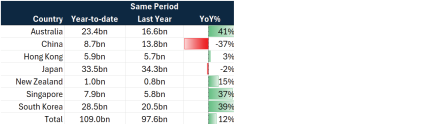
Investment momentum across developed Asia Pacific improved from July onwards and by September, volumes were up 12% year-over-year from the same period last year. Activity was better in nearly all markets, with the exception of China and surprisingly, Japan.
China’s slowdown is understandable given weak macro conditions and investment appetite. While the C-REIT market has performed well year-to-date, fundamentals in commercial real estate remain soft. The office sector faces a glut of deals but limited buyer interest. Japan’s volumes, on the other hand, remain broadly stable, and should be on track to match last year’s record high of JPY 7.4 trillion (USD 50 billion), reflecting continued healthy trading.
The most notable gains came from Australia, Singapore, and South Korea, each recording growth of 30 to 40% compared to last year. Hong Kong too saw a small uptick of 3% - led by the cautious return of families, opportunistic capital, and credit funds seizing discounted opportunities.
DEV APAC INCOME PRODUCING TRANSACTION VOLUMES 2015 TO 2024
NEW RETURN EQUATION
The pick up in activity is alongside lower interest rates, which has brought positive gearing back into view and improved the levered return outlook. Looking ahead, a “higher for longer” environment with a steepening yield curve means future returns will rely more heavily on NOI growth – although we have yet to see rent growth expectations materially shift upward. Even so, opportunities are emerging, with outcomes varied across sectors, countries, and cities, shaped by uneven fundamentals across demand and supply.
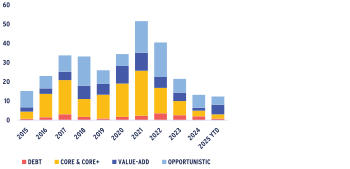
ASIA PACIFIC FUNDRAISING 2015 TO YTD 2025
Source: AEW Research, Bloomberg, Preqin as of end Sep 2025
Growth & Policy Support Recalibrated
GROWTH RESILIENCE IN ASIA PACIFIC SO FAR, BUT MAY WANE
By Q3, GDP in developed markets was running ahead of expectations from a few months ago. This resilience was supported by unique domestic demand drivers, fiscal support, AI-related tailwinds, but perhaps more significantly by export front-loading ahead of tariff implementation. This was evident in Singapore, Japan, and South Korea. Most economists now anticipate a slowdown in growth through the second half of 2025, as effects of front-loading fade.
China, mirroring this trend, recorded 4.8% growth in Q3 on a year-on-year basis, with a growth breakdown increasingly reliant on exports. Beijing’s attempts to boost domestic demand and advance supply-side reform through the anti-involution campaign are still seeing limited effects.
Looking ahead, potential sector-specific tariffs on pharmaceuticals and semiconductors present material risks for the region, though outcomes remain uncertain. Australia’s rare-earth agreement with the Trump administration provides medium-term growth support.
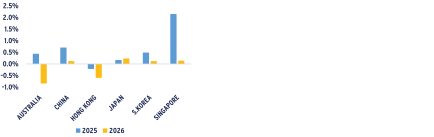
GDP GROWTH FORECASTS RECALIBRATED 2025 TO 2027
(OCT 2025 VS JUNE 2025)

RATE CUTS IN ASIA PACIFIC FEED THROUGH AHEAD OF THE U.S.
In the U.S., labor market weakness prompted the Fed’s Q3 pivot back to rate cuts, although this sits in a backdrop of lingering inflation risks.
Central banks in Asia Pacific are on divergent paths. South Korea and Singapore were dovish from 2024 to early 2025 but are now more cautious. In South Korea, housing prices remain a key concern for policymakers. Australia’s central bank meanwhile has been on a staggered reduction path, with inflation risks tilting to the upside but labor market softening slowly. Japan is moving in the opposite direction of policy tightening, though political leadership changes could still influence the BoJ’s resolve to raise rates.
POLICY RATES 2021 TO 2025

FISCAL SUPPORT IN SOME MARKETS
The near-term outlook is undeniably cloudy, but Asia Pacific does have levers to pull on fiscal spending. In South Korea, the new administration that took office in early 2025 has pledged additional fiscal support, including housing and green-energy programs, while Japan’s leadership change in October 2025 also came with commitments to stimulus, such as infrastructure upgrades. Singapore, meanwhile, has significant excess reserves, enabling the government to deploy spending on social transfers and industry support to cushion its highly open and externally exposed economy.
GOV EXPENDITURE TO GDP RATIO VS PRIOR YEAR CHANGE IN %-POINTS
Source: WEO Database, Bloomberg, as of end Sep 2025
Strategies Balance Early-Cycle Momentum & Late-Cycle Stability
LIVING & LODGING
SCALABILITY AND EXIT OPTIONALITY
More capital across opportunistic, value-add and core (as well as build-to-core), continue to pour into Asia Pacific’s living sector. Each market also benefits from distinct demographic and policy tailwinds, supporting a range of rental formats from student housing to mass-market rentals and senior living. Japan remains the most mature and institutionalized market, historically making up more than 50% of investment activity to-date. This year however, Australia has overtaken Japan in terms of volumes transacted year-to-date across student housing, seniors housing and build-to-rent – with a total of USD4.7 billion closed, mostly due to large portfolio deals. In South Korea (officetel-to-multifamily) and Hong Kong (hotel/office-to-student accommodation), conversion activity highlights early-stage market dynamics. Investors are gaining confidence as they see proof of product-market fit, scalability, and, most importantly, clearer exit options.
INDUSTRIAL & LOGISTICS
EXTENDED CYCLES IN AUSTRALIA AND RECOVERY DRIVEN MOMENTUM IN NORTH ASIA
Australia’s logistics market is diverging: after five years of rental growth, momentum is slowing in select areas but could extend where vacancy remains tight and new supply is constrained. In this phase, capital is leaning toward core strategies with stronger income security. By contrast, Greater Seoul’s dry logistics sector has already entered a measured rental recovery, supported by resilient demand and improved vacancy expectations amid construction delays. Greater Tokyo is on a similar trajectory, though structural vacancy in submarkets with weak accessibility may limit the pace of recovery. Both markets are drawing increased attention from return-seeking foreign investors.
OFFICE
WARMING INTEREST BUT CAPITAL IS SELECTIVE
Office transaction volumes have risen by almost 30%, led by South Korea and Japan where an active domestic capital base, spanning both value-add and core buyers has been driving activity. In Australia, cross-border investors have become much more prominent, accounting for 72% of Sydney office deals, though participation remains more limited in Melbourne, where mostly domestics are active today. Cap rates in Sydney’s CBD have already started to compress, while Melbourne is close to bottoming. Singapore continues to be a core buyers’ market, with limited repricing but NOI growth opportunity building through positive rent reversions. In Greater China, Hong Kong Grade B is seeing renewed interest, with discounted opportunities, particularly for conversion to alternative uses.
RETAIL
FROM UN-LOVED TO IN-VOGUE
Retail was one of the few sectors to see a meaningful increase in investor intentions from 2024 to 2025. Much of this interest has been concentrated in Australia, where favorable population growth, a resilient consumer base, attractive entry pricing, and limited new supply are expected to support rental growth in the near-term. Importantly, retail spending in Australia remains anchored in physical stores, even as e-commerce expands. Outside Australia, however, the picture is more mixed and challenging. Greater China and Hong Kong continue to face difficulties, Singapore struggles with high occupancy costs, and in Japan, yield spreads remain extremely tight—altogether limiting investor activity.
Living and Lodging
JAPAN: THE SHIFT TO HYBRID RESIDENTIAL-HOSPITALITY
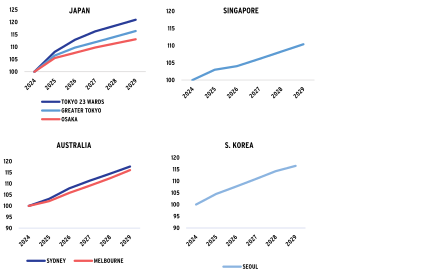
Multifamily has performed strongly - rents in Tokyo’s 23 wards are up 12% to 15% over the past three years. In 2025 up to Q3, rents are up 7%. New demand sources from tourists and foreign residents are driving demand for furnished units and short-stay rentals. These strategies fill market gaps but face policy risks, with short-stay licenses (minpaku) hard to secure and public rhetoric highlighting social concerns.
SINGAPORE: GRADUAL RENTAL GAINS
Singapore’s private residential rents rose 2.5% year-to-date by Q3, reversing the mild dip in 2024. New completions in 2025 are projected to be 40% lower than last year, while expat demand continues to grow. Rental growth should remain modest through year-end, before a larger supply in 2026 tempers the cycle.
AUSTRALIA: POSITIONED FOR INSTITUTIONAL EXPANSION
The residential sector should be due a solid upcycle, supported by population growth and a persistent housing shortage, though affordability constraints will limit the pace of growth. Even with completions projected to rise 20% above the long-term average in 2026, the supply gap will remain large. Still, it is worth noting that strong NOI growth does not always translate into superior returns, as tax leakage and structural barriers, most notably: 1) the limited access to stabilized product and; 2) reliance on development or build-to-core strategies, can impact outcomes.
HONG KONG: STUDENT ACCOMMODATION A BRIGHT SPOT
Student housing strategies are gaining momentum, underpinned by solid demand and a structural shortage of more than 50,000 beds (for non-local students), projected to persist over the next five years. Entry pricing in Hong Kong is particularly compelling, at roughly 50% below peak levels. Additional opportunities are likely to emerge as banks pressure owners to divest assets and as events such as HSBC’s privatization of Hang Seng Bank accelerate balance sheet clean-ups, creating potential for distressed acquisitions.
SOUTH KOREA: TRANSITION FROM JEONSE TO WOLSE
In South Korea, recent policy measures by the government are shrinking the size of Jeonse market through stricter loan regulations and are pushing more tenants to a monthly rent format. This is also sending apartment monthly rents to new highs up 3% to 4% in 2025 YTD. Both Jeonse and monthly rents are expected to continue to rise till the end of the year, which could prompt more policy intervention.
LIVING RENT INDEX 2024=100
Logistics
AUSTRALIA: LEASING ACTIVITY SURPRISES, MARKETS DIVERGE
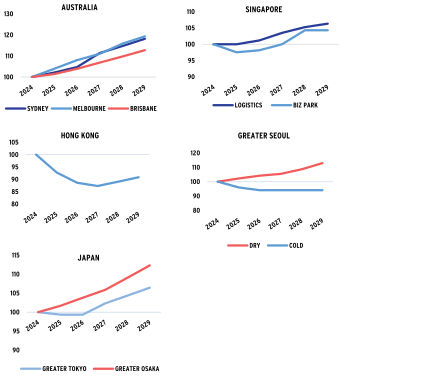
Leasing activity is expected to end the year with at least 20% improvement from 2024, showing overall resilience. Yet, the surge in supply has shifted conditions in favor of tenants. Incentives have increased and many projects under construction are seeking earlier pre-commitments as vacancy rates begin to climb. Supply is set to peak in Sydney in 2026/2027, while a 25% year-over-year drop in new supply in Melbourne in 2026 could give it the edge in effective rental growth.
SINGAPORE: SAFE HAVEN & ATTRACTIVE YIELDS
Demand for logistics in 2025 YTD has stayed above the 2024 trend, but new construction in 2025 has brought more leasing competition and rent reversions are expected to slow.
Business parks in non-central locations are starting to see conversions to alternative uses (like education, residential), which will slowly help soak up excess vacancy, and stabilize the market.
HONG KONG: RENT FORECAST REVISED DOWN, LIQUIDITY LIMITED
Front-loaded exports ahead of tariffs temporarily lifted Hong Kong’s trade figures, but fundamentals are still soft. Rising vacancy in prime warehouses is pressuring rents, prompting a downward revision in the two-year outlook. Investor activity has been muted, with just five deals over USD 20 million closed year-to-date. Steeply discounted pricing is starting to attract value-add and opportunistic capital.
SOUTH KOREA: DRY STORAGE CONTINUES TO IMPROVE AHEAD OF COLD STORAGE
The dry logistics segment has entered recovery, with yields compressing 40 bps and financing costs down 80–90 bps. Supply and vacancy risks are easing as new construction in 2026/2027 is projected to be 70% below the past three years, prompting upgrades to rent forecasts. The dry market took 2.5 years to stabilize, and we expect the cold segment will require a similar 2–2.5 years from its current position. Ongoing conversions from cold to dry are also helping to bring down overall stock.
JAPAN: PERFORMANCE WILL BE LOCATION SPECIFIC, INVESTMENT ACTIVITY MODERATING
In Greater Tokyo, market has been in a cycle of excess supply (especially in the inland markets), but by 2027, this is expected to reverse, which should make way for a broad market recovery. Regional cities like Osaka and Nagoya, have much more landlord favorable fundamentals and should outperform Tokyo based on NOI growth in the near-term.
LOGISTICS EFFECTIVE RENT INDEX
2024=100
Office
AUSTRALIA: ATTENTION IS ON SYDNEY & BRISBANE
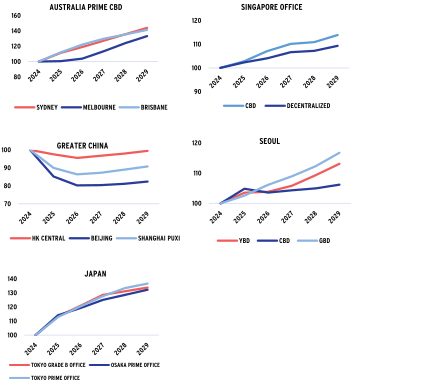
Investor focus is firmly on Sydney CBD, where a recovery is well underway, marked by seven consecutive quarters of positive take-up. Brisbane is also attracting attention, though its relatively small investable stock limits broader interest. Melbourne has trailed by nearly two years, but early signs of leasing momentum are beginning to surface.
SINGAPORE: STEADY IMPROVEMENT, BUYERS RETURN WITH CHEAPER DEBT
Leasing momentum is uneven by industry and location, but with limited contiguous space in the core CBD, further rental growth appears likely. The combination of positive rent reversions and a lower interest rate environment should help draw core buyers back into the market.
HONG KONG: MARGINAL IMPROVEMENT THROUGH ACTIVE IPO MARKET
Office rents have historically tracked closely with the stock market. The recent rally in the Hang Seng Index (with strong IPO volumes and southbound flows via Stock Connect) is bearing positive effects on the office market. Demand is also diversifying as education tenants become more active. The planned removal of Grade B stock through conversions will be helpful in reducing large existing vacancy.
CHINA: PROLONGED RENTAL WEAKNESS, CAPITAL ESCHEWS OFFICE
Shanghai and Beijing office markets show little prospect of near-term recovery. A supply glut is keeping vacancy above 20% and rents to drop down to roughly half their 2019 peak. Liquidity is scarce, with buyers limited to end-users focused on location, land tenure and naming rights. AEW Research estimates about USD 16 billion of office assets purchased by cross-border institutions between 2018 and 2022 remain unsold.
SOUTH KOREA: LATE CYCLE MOVEMENTS
Weakness in the CBD is becoming more evident, with the rental growth outlook downgraded as new supply enters the market and tenants shift to more affordable locations. By contrast, the outlook for GBD and YBD is more favorable. Office market transactions have been exceptionally strong, though rent reversions are expected to flatten going forward.
JAPAN: RENT AND VACANCY OUTLOOK UPGRADED
Both Tokyo and Osaka’s office market are showing positive momentum, with near-term rents having grown consistently for the past seven quarters and vacancy rates at multi-year lows of 0.9% (Tokyo C5W) and 2.5% (Osaka C5W) respectively. While rent reversions are expected to support NOI growth, investor focus has shifted toward value-add strategies, acknowledging the current stage of the interest-rate cycle.
OFFICE EFFECTIVE RENT INDEX
2024 =100
Retail
AUSTRALIA: OUTLOOK REMAINS POSITIVE ON LIMITED SUPPLY
Consumer confidence remains uneven. The Q3 2025 reading softened on the back of higher-than-expected inflation, raising doubts around the timing of rate cuts and adding uncertainty ahead of the holiday spending season.
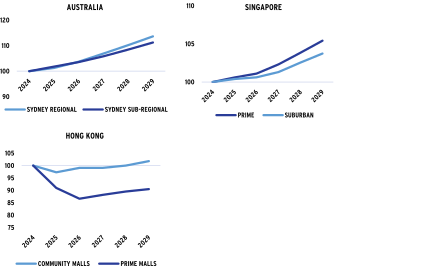
Even so, population-driven volume growth, limited new supply, and attractive entry pricing have positioned the sector favorably. Banks are lending at competitive margins, investment volumes are up 30% year-on-year, and retail yields, like other Australian sectors, have begun to compress.
SINGAPORE: SUBURBAN RESILIENCE BUT RISING CHALLENGES
In Q3, retail sales were temporarily supported by the “SG60” vouchers, which boosted spending in covered categories such as supermarkets and selected F&B. However, other discretionary segments remained weak, highlighting a cautious spending environment. Further, headlines of multiple F&B closures in Q3, citing rising occupancy and labor costs, underscore the challenging operating backdrop.
Rents have been flat- over the last 12 months, suggesting growth may be approaching its ceiling in the current environment. Nonetheless, investment momentum should remain firm into 2025, with several large transactions expected to close in Q4.
HONG KONG: LIKELY TO SEE FURTHER DOWNTURN
We believe retail sales have finally bottomed, with four consecutive months of growth by August 2025, ending a 14-month run of year-on-year declines. Despite this improvement, a full recovery may take time as Hong Kong prices adjust to remain competitive with affordability across the border in mainland China.
RETAIL RENT INDEX
2024 =100
For more information, please contact:
HANNA SAFDAR
Head of Research and Strategy, Asia Pacific
hanna.safdar@aew.com
+65.6303.9014
JAY STRUZZIERY, CFA®
Head of Investor Relations
jay.struzziery@aew.com
+1.617.261.9326
This material is intended for information purposes only and does not constitute investment advice or a recommendation. The information and opinions contained in the material have been compiled or arrived at based upon information obtained from sources believed to be reliable, but we do not guarantee its accuracy, completeness or fairness. Opinions expressed reflect prevailing market conditions and are subject to change. Neither this material, nor any of its contents, may be used for any purpose without the consent and knowledge of AEW. There is no assurance that any prediction, projection or forecast will be realized.