
Survived ’25, but No Quick Fix in ‘26
APAC PRIVATE REAL ESTATE: SOMEWHAT STRONGER FOOTING IN 2026
Markets have absorbed a steady drumbeat of shock events over the past 12 months, spilling into 2026. From trade-wars to physical wars, policy reactions and strained geopolitics. Each episode has reinforced caution, yet have seen surprisingly muted reactions in public markets, which continue to grind higher.
In private real estate in APAC, 2025 ended on a more constructive note than it began. Interest rates generally moderated, investment activity picked up, and fundraising momentum improved at the margin. It can also be argued that fundamentals are turning more favorable in key markets. But going forward, investors will have to grapple with limited interest rate relief and a growth environment disproportionately driven by AI-linked capex and productivity hopes. So, while it appears we have survived the hard parts of 2024 and 2025, there is no quick fix in 2026.
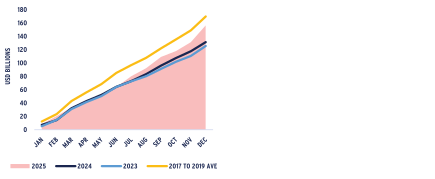
DEV APAC INCOME PRODUCING TRANSACTION VOLUMES 2017 TO 2025
Source: AEW Research, MSCI, JLL, CBRE as of end Dec 2025
INVESTMENT ACTIVITY IMPROVES IN 2025, GOOD SET-UP FOR 2026
Overall investment volumes were up 15% y-o-y in 2025, with much of that improvement concentrated in the second half of the year, in line with the interest rate reductions that came through in Australia and Singapore. Across Australia, Singapore and South Korea, investment volumes were up anywhere between 40 to 50% year-on-year. Volumes also improved in Hong Kong, where signals the market could be bottoming has prompted more institutional activity on top of previously dominant local families and end users. While activity is up, liquidity has not fully normalized as capital continues to be extra selective of where to allocate, either along structural thematic sectors or where NOI growth looks particularly positive. For investment activity in 2026, we expect it to resemble the pace seen in 2025. We might see a stronger rotation into safe haven markets like Singapore, while the amount raised for Australia and Japan-only strategies should support deployment activity in these markets.
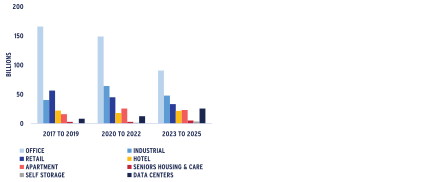
DEV APAC TRANSACTION VOLUMES BY SECTOR 2017-19 vs 2020-22 vs 2023-25
Source: AEW Research, MSCI, JLL, CBRE as of end Dec 2025
TOTAL RETURNS MODERATE UNEVENLY
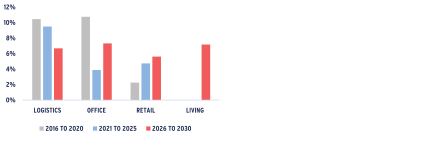
In a higher-rate, structurally lower-growth environment, market-driven total returns are inherently more muted. While fundamentals remain supportive in select markets, with income growth of only around 4–5% p.a., the post-downturn cyclical upswing that investors have historically relied on is unlikely to emerge. As a result, investment outcomes may be less driven by broad market tailwinds and increasingly on alpha generation, through disciplined asset selection, attractive entry pricing, selective risk-taking, and strong operational execution.
ASIA PACIFIC TOTAL RETURN (AVE EX. CHINA) 2016 TO 2030F
Source: AEW Research, MSCI, JLL, CBRE as of end Dec 2025
Growth Stabilizes in 26, Limited Policy Room
GROWTH FORECAST FOR 26’ IMPROVED AT THE MARGIN
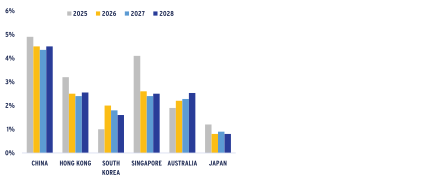
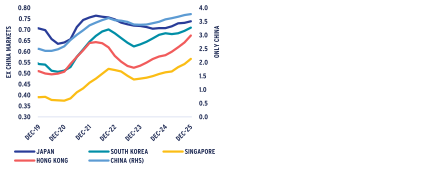
Growth expectations for 2026 have edged higher versus mid-2025, supported by lower-than-expected tariffs and a lift in exports driven by the AI and semiconductor cycle, particularly in North Asia. China ended 2025 with a record USD 1.2 trillion trade surplus, but flat imports highlight persistent domestic demand weakness. A comparable though less acute dynamic is evident in Singapore, South Korea, and Japan, where export growth in 2025 (between 3 and 5% y-o-y) generally outpaced consumption and retail activity.
GDP GROWTH FORECASTS 2026 TO 2028
Source: WEO Database, Bloomberg, as of end Dec 2025
SOME GOOD NEWS AHEAD, BUT WITH OFFSETTING FACTORS
Several pockets of positive news have and will continue to emerge in Q1 2026. In Japan, further fiscal stimulus is expected, while Shunto wage negotiations point to another year of strong wage growth, likely exceeding 5% year-over-year. In China, additional policy support is anticipated following the NPC meetings. Australia continues to stand out in APAC, with household spending showing good momentum, underscoring relatively resilient domestic demand. These positives, however, come with trade-offs. In Japan, stronger wages and fiscal support are adding upward pressure on bond yields, while in Australia, firmer domestic conditions have already prompted a rate hike in February 2026.
APAC EXPORT VOLUMES IN USD TRILLION 2019 TO 2025
Source: WEO Database, Bloomberg, as of end Dec 2025
FURTHER MONETARY EASING LIMITED
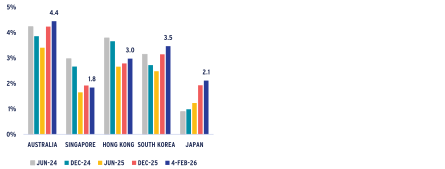
The magnitude of rate cuts across APAC has been more limited than initially expected, and scope for further easing now appears constrained. In South Korea, references to additional rate cuts have been removed from recent policy meeting minutes, while in Singapore, core inflation is expected to trend higher in 2026, keeping monetary policy on hold. In Australia, risks remain tilted toward further rate hikes rather than cuts. Japan, meanwhile, continues along a gradual and measured path toward policy normalization, carefully balancing domestic growth, fiscal pressures, and capital-market dynamics—particularly currency stability.
At the global level, questions surrounding the Federal Reserve’s independence have added to policy uncertainty. Should the Fed ultimately deliver deeper rate cuts, this could reopen policy space for APAC central banks to respond more accommodatively.
5Y SWAP RATES (TO 3M FLOATING) OVER TIME 2024 TO CURRENT
Source: WEO Database, Bloomberg, as of end Dec 2025
Adapting Strategy to Divergent Cycles
LIVING
Policy Moving to the foreground in some markets
The living sector remains one of the fastest-growing real estate segments in APAC. Investor appetite remains strong: Australia BTR topped global investment intention rankings, while Sydney, Melbourne, Tokyo, and Osaka residential all featured among the top five city-sector combinations as target destinations for investors.
Investment volumes in income producing multifamily, student housing, and seniors housing reached US$16 billion in 2025, up more than 40% year-on-year, with the strongest growth seen in Australia, Singapore, and South Korea.
However, as housing affordability remains a growing focus, the policy backdrop is becoming an increasingly important consideration. In Seoul, the new administration introduced tighter LTV limits and higher tax burdens, measures that are likely to weigh on returns for corporate landlords and potentially constrain further investment. In Japan, rising concerns around overtourism and the growing presence of non-locals have also entered the political spotlight. While these dynamics had previously supported strategies such as minpaku leases, social backlash has led the Osaka government to halt new permits, underscoring the growing policy sensitivity surrounding living-sector investments.
INDUSTRIAL & LOGISTICS
Extended cycles in Australia and recovery driven momentum in North Asia
Higher construction costs and delayed supply continue to shape conditions across the industrial and logistics sector. These constraints are extending rental cycles in Australia and supporting an early recovery in rents in South Korea (Greater Seoul) and Japan (Greater Tokyo). In Australia, leasing incentives appear to have overshot levels typically associated with a sub-4% vacancy market, suggesting scope for a gradual normalization from the second half of 2026. In contrast, in Greater Seoul and Japan, declining new supply alongside steady demand is reinforcing confidence in both rental and investment recoveries. Reflecting this, cross-border investor participation in these markets increased by approximately 35% between the first and second half of 2025. In Singapore, the re-expansion of yield spreads to levels last seen in 2017 (thanks to lower debt costs) has similarly improved sentiment, drawing renewed interest from fund managers.
OFFICE
Turning positive across a broader set of markets
The APAC office sector ended last year on a more positive note, with total demand reaching approximately 13 million sq ft, the highest level recorded since the pre-COVID peak in 2018. A closer look, however, shows that over 50% of this demand was driven by Japan, where the outlook has improved steadily over the past few quarters. Outside Japan, recent upward revisions to forecasts point to improving conditions in the Sydney and Brisbane CBDs, and may also signal that the office market in core Hong Kong is approaching a cyclical bottom. Additionally, we are turning more constructive on Singapore where we expect rent reversions over 2026 and 2027 to reach high single digits or low double digits.
RETAIL
Retail returns as an income-led opportunity
Renewed investor interest in retail reflects a broader global theme, with appetite returning across key markets. E-commerce penetration has largely plateaued, retail yields have reset, and the outlook for income and total returns is more favorable than in recent years. While consumer confidence and spending remains uneven across APAC, retail investment allows for selectivity, with well-located assets in resilient neighborhoods and clearly defined catchments better positioned to capture stable consumer demand. Transaction activity rebounded in 2025, led by Australia, New Zealand and Singapore. In Australia, volumes were boosted by several large regional mall trades, making a repeat of record activity in 2026 unlikely. In Singapore, momentum remained strong, and with more assets expected to come to market, another solid year of retail transactions is likely.
Living & Lodging
JAPAN
Late-cycle rents, early signals for affordable formats
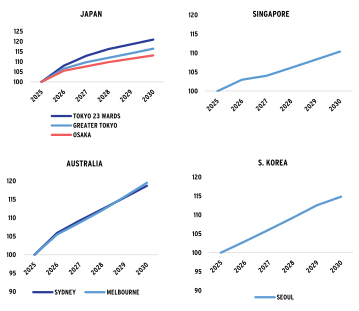
Rents continued to rise across the 23 wards; however, as affordability pressures intensify, rent growth in the C5W has begun to plateau. While wage growth is set for another solid year in Japan, gains are uneven across the population. With market rents now approximately 20 to 25% above 2021 levels, this widening affordability gap is increasing the demand and rationale for more affordable housing formats.
SINGAPORE
Gradual rental gains
Private residential rental outlook is broadly stable, with mild downside risk as new completions expand year-over-year in 2026. Still investor interest in alternative living formats continues, especially for student housing, which are driven less by supply cycles and more by willingness to pay for safe, well-located accommodation. Recent listings by co-living operators have provided positive market validation, reinforcing confidence in the profitability of these alternative living models.
AUSTRALIA
Strong income offset by rising interest costs
Structural undersupply across the living sector continues to support a strong rental growth outlook across BTR, student housing and co-living. Affordability pressures are emerging for international students, while in BTR developers are responding by scaling back amenities and delivering more compact, mid-market units better aligned with affordability thresholds. We estimate rental growth of 6–7% in 2026, although stronger income growth may be partially offset by rising interest costs.
HONG KONG
A bright spot, longer-term supply considerations
Student housing remains a bright spot in Hong Kong. Upcoming government land sales (which could deliver around ~4,500 units between 2028 and 2029) reinforce government support for the sector but could add supply risks in coming years. Today however, a better outlook for the residential market is reinforcing demand for purpose-built student accommodation, supported by spillover effects and historically linked rental cycles between student and private housing.
SOUTH KOREA
Transition from Jeonse to Wolse
Policy changes implemented in H2 2025 may weigh on deal feasibility in South Korea’s emerging living sector. The reduction of LTVs to zero and the application of the Comprehensive Real Estate Holding Tax (CRET) on owners of multiple properties in designated areas have significantly increased holding costs. In response, some investors are reassessing the sector or pursuing alternative pathways such as hotel-to-multifamily to navigate the regulatory framework.
LIVING RENT INDEX 2025=100
Source: AEW Research, Q4 2025
Logistics
AUSTRALIA
Resiliency in <5,000SQM tenancies
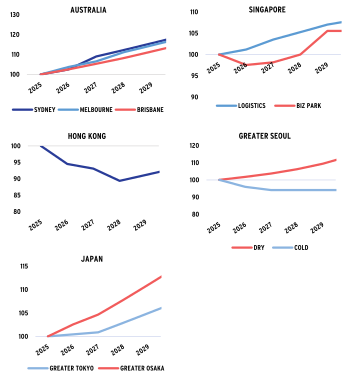
Despite late-cycle conditions, supply remains relatively constrained against supportive structural fundamentals, including population growth and rising household incomes, which should continue to underpin demand. As demand normalizes from COVID-era highs, opportunities could be interesting in the underserved small- to mid-tenant segment, where incentives are lower and tenant demand remains relatively resilient.
SINGAPORE
Momentum moderates
Demand for logistics and warehouse space in 2026 is expected to moderate compared with recent years. Some demand may be diverted to Johor, supported by the SEZ, while the rollover of several large leases over the next 12 months is likely to lead to a degree of tenant consolidation. The business parks market continues to be two-speed, with location remaining the key determinant of performance.
HONG KONG
Rent forecast revised down, liquidity returning selectively
Hong Kong’s export activity in 2025 broadly mirrored the strength seen in China over the same period. However, this has had limited positive spillover into the warehouse market, where vacancy rates remain elevated. We stay cautious on the outlook, as export growth in 2026 may slow due to payback effects from earlier front-loading. That said, investor interest is beginning to return selectively in specialized industrial segments, such as data centers and cold storage, which are less directly exposed to the export cycle.
SOUTH KOREA
Dry storage continues to improve ahead of cold
The recovery in the logistics market remains uneven. Dry logistics is showing clear signs of improvement, with occupied stock up 11% over the past year, while the cold segment continues to lag, up only 2% over the same time period. Looking ahead, a slowdown in new supply over the next two years supports a meaningful downward revision to vacancy forecasts, allowing rent reversions in the dry segment to turn modestly positive. Investment activity also finished 2025 on a strong note, although headline volumes were inflated by a small number of large transactions.
JAPAN
Performance will be location specific, investment activity moderating
In Greater Tokyo, a meaningful downward revision to the supply pipeline is supporting an improvement in rental conditions. After nearly five years of flat rents, landlords are seeing greater upside in lease negotiations, although the recovery is expected to be location-specific, particularly in inland markets where vacancy levels and supply risk vary widely across submarkets. In regional cities, the outlook is incrementally more positive, supported by lower vacancy rates and the continued expansion of e-commerce into regional locations.
LOGISTICS EFFECTIVE RENT INDEX 2025=100
Source: AEW Research, JLL, CBRE as of Q4 2025
Office
AUSTRALIA CBD
Each city tells a different story
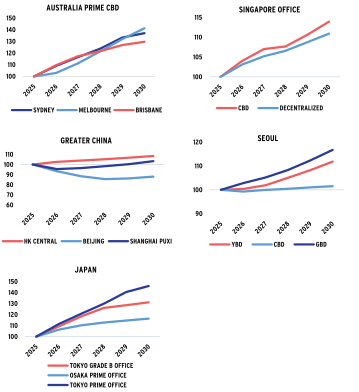
In Sydney, occupier demand has broadened from core CBD, with capital following. Brisbane’s fundamentals remain strong, but limited investable stock and foreign-owner taxes continue to act as hurdles. Melbourne faces a more challenging outlook, with potentially a weak 2026 as new supply completes with limited pre-commitment.
SINGAPORE
A pick-up in fundamentals and investor interest
Rental growth should remain healthy over the next few years, supported by improving demand conditions, with positive reversions likely as heavily discounted leases roll off. Investment activity has also picked up, with large-scale capital moves reinforcing confidence in the market.
HONG KONG
At an inflection point?
Take-up rebounded in 2025, surpassing 2 million sq ft, a new high since 2018. Demand was led by the financial sector, securing favorable terms at prime offices. While vacancy is still elevated and will take time to absorb, downside risks are narrowing, and rents in Central are forecast to rise by 3–4% in 2026. Investor interest could return in 2026, alongside falling interest rates, but expected to be driven largely by conversions.
CHINA
Prolonged rental weakness, some alternative exit routes?
Liquidity remains thin as macro headwinds persist. The buyer universe is largely domestic and pricing in substantial discounts. Against this backdrop, alternative exit routes are moving up the agenda, including continuation vehicles and, potentially, the evolving C-REIT market. Recent policy adjustments now allow Grade A office assets into the C-REIT framework, though execution hurdles remain, particularly for assets with shorter land tenure.
SOUTH KOREA
YBD and GBD move ahead of CBD
The impact of the CBD’s new supply is expected to become more evident by mid-2026, likely leading to a reversal in face rent growth within the submarket. By contrast, the outlook for GBD and YBD remains more favorable. Office transaction volumes reached a record level in 2026, supported by strong domestic capital, which is expected to remain active.
JAPAN
Rent and vacancy outlook upgraded
Both Tokyo and Osaka office markets are exhibiting strong positive momentum across Grade A and Grade B assets. Near-term rental forecasts have been revised upward for eight consecutive quarters, supported by vacancies at multi-year lows of 0.9% in Tokyo (C5W), and 2.5% in Osaka (C5W). Investment activity is also picking up; while historically dominated by domestic buyers, foreign capital is becoming increasingly active and is underwriting more aggressive rent growth assumptions.
OFFICE EFFECTIVE RENT INDEX 2025=100
Source: AEW Research, JLL, CBRE as of Q4 2025
Retail
AUSTRALIA
Outlook remains positive on structural factors
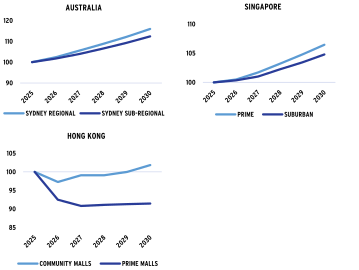
2025 recorded a notably high level of large-ticket transactions, and while transaction volumes are unlikely to be repeated at last year’s peak levels, retail investments are still expected to remain active. Australian consumer fundamentals remain broadly healthy, underpinned by a tight labor market, and resilient consumer spending. Looking ahead, favorable demographic trends and continued population growth should provide structural support for retail turnover growth over time.
SINGAPORE
Suburban resilience but rising challenges
Occupier demand from new retail entrants in Singapore remains nuanced. While F&B, traditionally one of the more resilient segments, has experienced elevated churn as operators manage rising rents and manpower costs, leasing momentum has been stronger among health- and lifestyle-oriented brands. Despite a relatively subdued consumer backdrop, spending and footfall in neighborhood locations has remained resilient. Investment activity picked up materially in 2025, and 2026 is shaping up to be another active year for the sector. In addition, many malls continue to have passing rents well below current market levels, creating scope for healthy, positive rental reversions.
HONG KONG
Likely to see further downturn
Hong Kong retail sales growth was positive for the whole second half of 2025, giving confidence in the recovery story. Performance however has been uneven across categories: consumer durables, electronic goods, and jewelry and watches have performed well, while spending on fuel, clothing, and everyday necessities has continued to decline. This divergence suggests that local consumption remains under pressure, with spending still leaking northbound to the Mainland, overseas travel, and e-commerce platforms. As a result, we expect a full recovery to take time, particularly as Hong Kong prices continue to adjust to remain competitive with affordability across the border.
RETAIL RENT INDEX 2025=100
Source: JLL, AEW Research, as of Q4 2025
For more information, please contact:
HANNA SAFDAR
Head of Research and Strategy, Asia Pacific
hanna.safdar@aew.com
+65.6303.9014
JAY STRUZZIERY, CFA®
Head of Investor Relations
jay.struzziery@aew.com
+1.617.261.9326
This material is intended for information purposes only and does not constitute investment advice or a recommendation. The information and opinions contained in the material have been compiled or arrived at based upon information obtained from sources believed to be reliable, but we do not guarantee its accuracy, completeness or fairness. Opinions expressed reflect prevailing market conditions and are subject to change. Neither this material, nor any of its contents, may be used for any purpose without the consent and knowledge of AEW. There is no assurance that any prediction, projection or forecast will be realized.