
Essential housing performance, in aggregate, was modest during 2025. Demand remained positive, albeit slowing throughout the year. New supply seemingly peaked and began to roll off. Overall, average vacancies continued to rise in the EHF segment while average market rent growth decelerated materially. Heading into 2026, fundamentals for essential housing are expected to stabilize and begin to improve as new supply continues to slow and renter demand driven by relative affordability continues. Despite this, near-term uncertainty, particularly with respect to immigration, will contribute to differentiated outcomes by market.
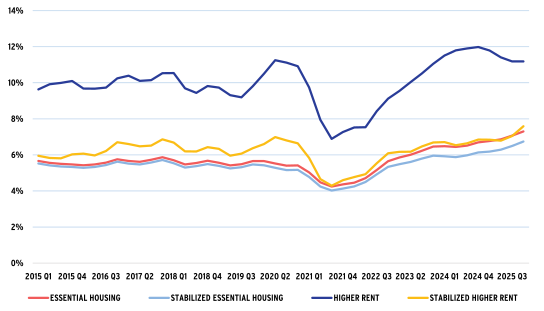
Stabilized U.S. rental housing market occupancy, in aggregate, was mixed during the fourth quarter as evidenced by reported statistics from groups such as CBRE and Costar. For their part, CBRE reported a 50-basis point increase in overall vacancies, moving from 4.4% to 4.9%, while CoStar recorded a small increase from 8.4% to 8.5%. For essential housing, the overall vacancy rate rose from 6.5% to 6.7% during the quarter, in-line with the stabilized vacancy rate for higher rent apartment properties. Interestingly, the overall vacancy rate reported by CoStar for higher rent properties has steadily improved since the end of 2024, but this improvement has been from significantly higher levels as newly delivered, mostly vacant high rent properties have begun to lease, suggesting some catch-up after several years of high construction in this segment.
FIGURE 1: U.S. APARTMENT MARKET VACANCY RATE
Source: CoStar, 2025 Q4
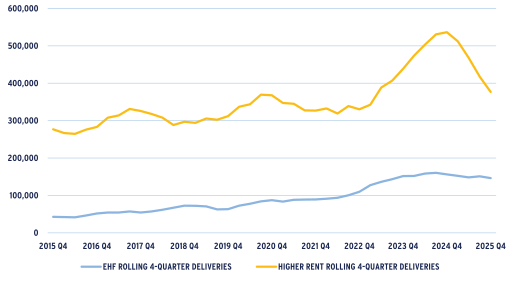
To this point, Figure 2 illustrates the pace of higher rent unit deliveries over the past decade relative to deliveries in the essential housing segment of the market. During 2025, new deliveries in the higher rent segment were approximately three times greater than the essential housing segment even though the absolute size of the essential stock is more than twice the size of the higher rent stock in total units. As we have observed previously, this supports our belief that the higher rent segment of the apartment represents the lion’s share of new supply risk and the various negative impacts of new supply with respect to occupancy and rental rates, leaving essential housing chronically undersupplied.
FIGURE 2: NET NEW APARTMENT DELIVERIES
Source: CoStar. 2025 Q4
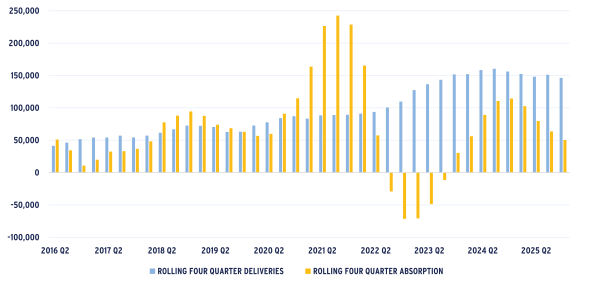
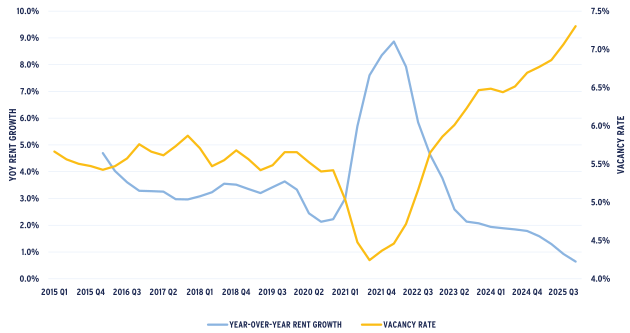
Taken together, the supply and demand picture of U.S. essential housing is mixed. While the net delivery of new units to the segment is limited in both total units as well as share of existing stock, absorption is also soft and has been weakening over the past four quarters (Figure 3). Fourth-quarter net deliveries have remained higher than absorption. The resulting recent rise in vacancy rates has, in large part, led directly to the corresponding slowdown in rent growth (Figure 4).
FIGURE 3: ESSENTIAL HOUSING SUPPLY & DEMAND
Source: CoStar, 2025 Q4
FIGURE 4: ESSENTIAL HOUSING RENTAL RATE GROWTH & VACANCY RATE
Source: CoStar, 2025 Q4
In part, this reflects a broad trend of slowing economic growth as the post-pandemic spending stimulus and, perhaps more importantly, job growth continues to dissipate. More significantly for essential housing, lower income households are more burdened by lingering higher inflation and, at the same time, are not participating in the broader wealth effect, benefiting higher income households, particularly with respect to ever higher equity market and home values.
More recently, and over the near-term, aggregate demand for apartments and all manner of consumer goods, will be constrained by negative net migration originating in foreign born residents leaving, both by force and by choice, combined with fewer people in other countries electing to move here. For the first time in 50 years, the U.S. has experienced negative net migration. Brookings estimates that for 2025 total net migration to be between -295,00 and -10,000. While there is debate on just how many immigrants have left the country, either through self-deportation or more direct immigration enforcement actions, the drastic change in population trends within the U.S. is significant to the health of the essential housing market. On average, foreign born workers have lower incomes than native born so it is likely that the impact of this net decline in population will be felt disproportionately in the segment of the housing market, most likely to house below median income workers, i.e., essential housing.
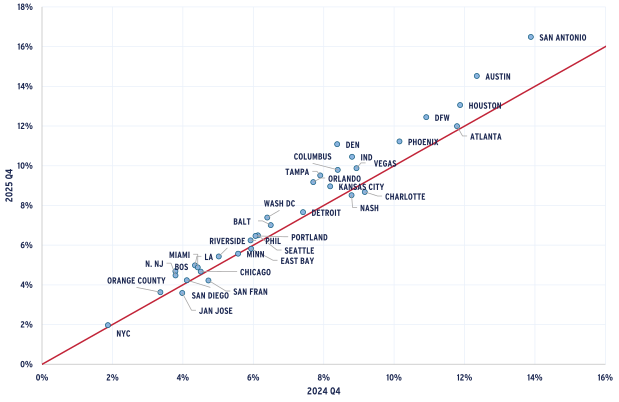
Finally, with respect to the geographic distribution of the trends, Figure 5 illustrates the change in essential housing vacancy rate over the past year by market. Markets above the diagonal line experienced vacancy increase while markets below the line showed improvement. Of the 40 major markets shown, only six experienced vacancy improvement over the four-quarter period, with Charlotte, San Francisco and Northern N.J. showing the greatest absolute improvements. The further the market moved away from the line, the greater the increase or decrease in vacancy. There are clear clusters of markets that have high current vacancy rate and experienced large increases in vacancy over the past year such as the primary Texas markets of Dallas, Houston, San Antonio, and Austin as well as Denver.
Going forward, there will be continued concern for markets with significant share of foreign-born households. In general, the large coastal gateway markets such as New York and Los Angeles have the largest aggregate population of foreign-born residents while markets such as Miami and San Jose are believed to have the highest concentration of foreign-born residents.
FIGURE 5: ESSENTIAL HOUSING APARTMENT VACANCY RATE 2025 Q4 VS 2024 Q4 BY MARKET
Source: CoStar. 2025 Q4
For more information, please contact:
MICHAEL ACTON, CFA®
Managing Director, Head of Research & Strategy, North America
michael.acton@aew.com
+1.617.261.9577
JAY STRUZZIERY, CFA®
Head of Investor Relations
jay.struzziery@aew.com
+1.617.261.9326
This material is intended for information purposes only and does not constitute investment advice or a recommendation. The information and opinions contained in the material have been compiled or arrived at based upon information obtained from sources believed to be reliable, but we do not guarantee its accuracy, completeness or fairness. Opinions expressed reflect prevailing market conditions and are subject to change. Neither this material, nor any of its contents, may be used for any purpose without the consent and knowledge of AEW. There is no assurance that any prediction, projection or forecast will be realized.