
The essential housing1 sector posted positive, albeit modest, performance in the first quarter of 2026. The data continues to show that while all segments of the apartment market remain under pressure, the balance of new development remains heavily concentrated in higher-rent product, shaping near-term performance and medium-term risk across the rental residential market.
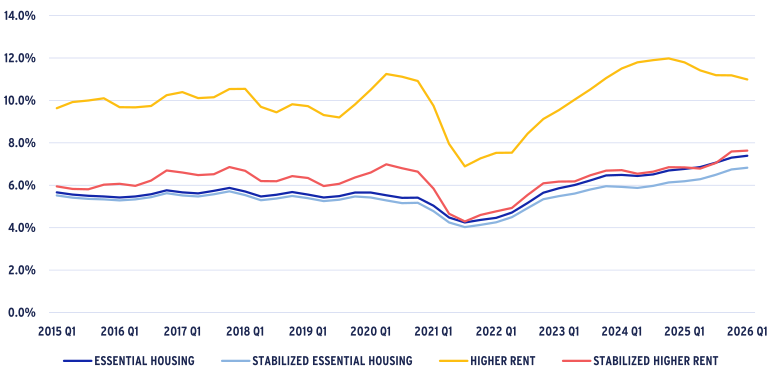
Essential housing vacancy continued to rise amid modest demand and a still-elevated level of supply. As of 2026 Q1, overall essential housing vacancy reached 7.39%, up 60 basis points year-over-year. For its part, stabilized essential housing vacancy increased to 6.83%, rising a similar 63 basis points versus 2025 Q1. Effective rents in the segment averaged $1,493 per unit and grew only 0.49% year-over-year, underscoring the extent to which elevated vacancy continues to constrain pricing power in the segment.
FIGURE 1: APARTMENT VACANCY RATE
Source: CoStar, 2026 Q1
Across the broader apartment market, higher-rent fundamentals also remained soft, though recent leasing trends suggest some normalization in demand. Overall higher-rent vacancy was 11% in 2026 Q1, improving 86 basis points from one year earlier. However, stabilized higher-rent vacancies rose to 7.6%, up 78 basis points year-over-year. Effective rents averaged approximately $2,140 per unit and declined 0.5% year-over-year, reflecting continued use of concessions and competitive lease-up conditions in recently delivered units.
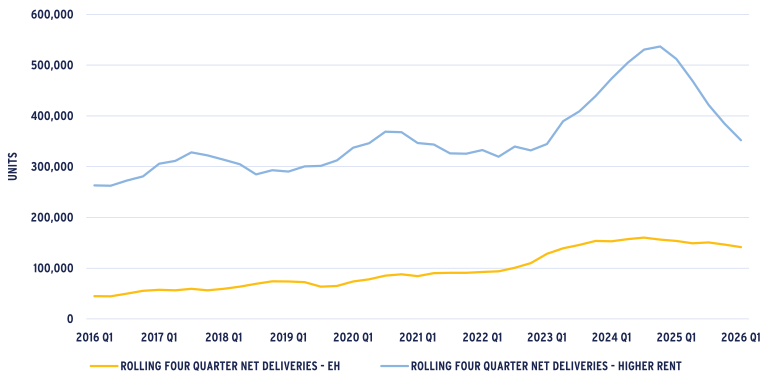
Supply dynamics remain a key driver of current fundamentals, with new deliveries continuing to skew disproportionately toward higher-rent properties. During 2026 Q1, essential housing deliveries totaled approximately 32,700 units, compared with the more than 67,000 units in the higher-rent segment, or about 2.0x as many units delivered at the upper end of the market. On a trailing four-quarter basis, higher-rent deliveries totaled more than 352,000 units versus nearly 141,500 units in essential housing, a ratio of approximately 2.5x. This remains notable given that essential housing still comprises more than two-thirds of total apartment inventory, compared with only one-third for higher-rent units.
The forward pipeline also remains tilted toward newer, higher-rent product. As of 2026 Q1, approximately 395,400 higher-rent units were under construction nationally, compared with about 183,570 units in the essential housing segment, implying a pipeline roughly 2.1x larger for higher-rent properties. In our view, this continues to support the broader thesis that the bulk of near-term supply risk remains concentrated in newer, more expensive units, even as near-term demand in essential housing has softened.
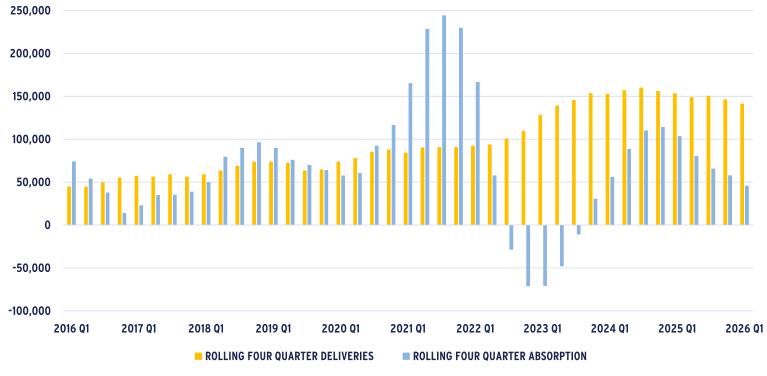
Demand trends further illustrate the divergence between segments. Essential housing absorption totaled only 12,278 units during 2026 Q1, trailing quarterly deliveries by approximately 20,423 units. On a rolling four-quarter basis, essential housing absorbed about 45,840 units versus 141,450 units delivered, a shortfall of roughly 95,600 units. By contrast, higher-rent absorption totaled approximately 73,240 units in the quarter, exceeding deliveries by about 6,090 units; over the trailing four quarters, higher-rent absorption reached 366,518 units, modestly ahead of the 352,047 units delivered over the same period. This suggests that newly delivered higher-rent properties are beginning to lease, while essential housing continues to experience weaker near-term demand relative to supply.
FIGURE 2: SUPPLY & DEMAND OF ESSENTIAL HOUSING
Source: CoStar, 2026 Q1
FIGURE 3: NET NEW APARTMENT DELIVERIES
Source: CoStar, 2026 Q1
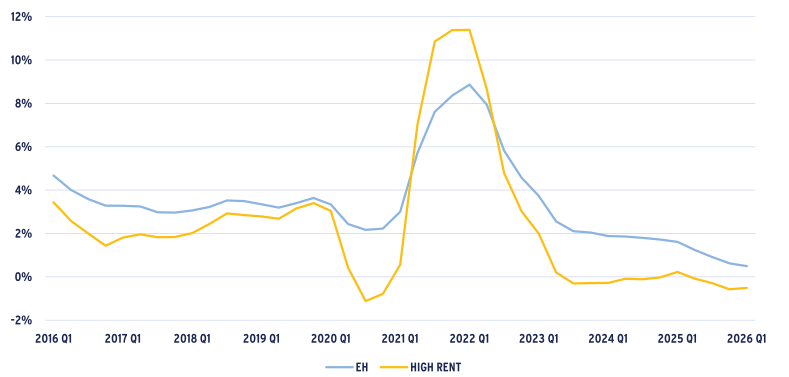
The recent rise in essential housing vacancy has continued to weigh on rent growth. Effective rent growth in the segment decelerated to just 0.5% year-over-year in 2026 Q1, down meaningfully from the higher rent growth rates observed earlier in the cycle. While essential housing rents remain nominally positive on a year-over-year basis, the current pace of growth is consistent with subdued occupancy conditions and limited pricing power.
At the same time, higher-rent effective rent growth was -0.5% year-over-year in 2026 Q1, remaining in negative territory despite some improvement in absorption. That combination of elevated vacancy, negative effective rent growth, and a still-heavy construction pipeline continues to reinforce that supply-related pressure is greatest in the upper end of the apartment market.
FIGURE 4: YEAR-OVER-YEAR GROWTH IN AVERAGE EFFECTIVE RENT
Source: CoStar, 2026 Q1
In aggregate, first quarter 2026 data suggests that essential housing has not yet reached a clear inflection point. Vacancy continues to trend higher, absorption remains modest, and rent growth has slowed. However, because the development pipeline remains disproportionately concentrated in higher-rent product, essential housing should remain comparatively better positioned from a medium-term supply perspective once demand normalizes and the current wave of new deliveries is absorbed. Overall, this quarter reinforces a familiar pattern: near-term apartment fundamentals remain soft, but supply pressures are not evenly distributed across the market. Although essential housing performance has recently weakened, its relatively limited construction pipeline compared to higher-rent product continues to support the view that it may be better positioned as demand stabilizes and excess supply is absorbed.
1 Essential housing is defined here as the aggregate of 1-, 2-, and 3-star apartment properties within the CoStar ranking framework, while higher-rent housing refers to 4- and 5-star properties
For more information, please contact:
MICHAEL ACTON, CFA®
Managing Director, Head of Research & Strategy, North America
michael.acton@aew.com
+1.617.261.9577
JAY STRUZZIERY, CFA®
Head of Investor Relations
jay.struzziery@aew.com
+1.617.261.9326
This material is intended for information purposes only and does not constitute investment advice or a recommendation. The information and opinions contained in the material have been compiled or arrived at based upon information obtained from sources believed to be reliable, but we do not guarantee its accuracy, completeness or fairness. Opinions expressed reflect prevailing market conditions and are subject to change. Neither this material, nor any of its contents, may be used for any purpose without the consent and knowledge of AEW. There is no assurance that any prediction, projection or forecast will be realized.