
Sentiments Retreats on Middle East Conflict
After years of gradual recovery, Asia Pacific real estate entered 2026 in better shape than it had been in years. That progress is now at risk.
The closure of the Strait of Hormuz has triggered supply and price shocks across oil, gas and commodities, and as with the tariff disruptions of 2025, Asia Pacific bears a disproportionate share of the impact. Investors are taking note. While few are stepping back entirely, capital deployment has generally slowed as the market pauses to reassess. The most consequential shift has been in financing conditions. Rising risk-free rates and higher debt costs are meaningfully compressing forward-looking returns and, for some, resetting return expectations.
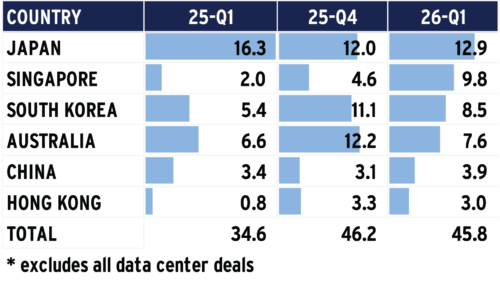
DEV APAC INCOME PRODUCING TRANSACTION VOLUMES Q1 2025, Q4 2025 & Q1 2026 (IN USD BILLIONS)
Source: AEW Research, MSCI, Bloomberg, April 2026
Market Level Activity Diverges
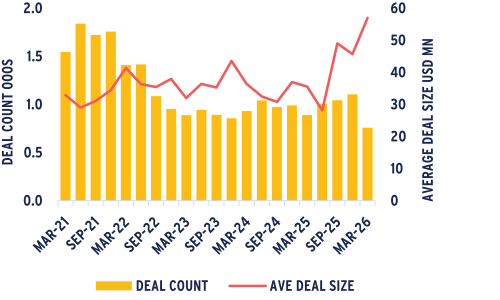
Q1 2026 volumes held up on the surface, but deal count fell 30% q-o-q. Moreover, most transactions take three to six months to reach financial close, so current figures do not yet fully reflect the shift toward a more risk-off environment. Activity is expected to remain measured while the conflict is unresolved. Our original expectation of 20% volume growth in 2026 has been revised down to flat to 10%.
Japan and Singapore accounted for an outsized share of Q1 activity, led by a handful of large office deals that lifted average transaction size. In Australia, retail transactions supported volumes, but overall activity fell close to 40% quarter-on-quarter. Japan and Singapore should continue to lead volumes through 2026, underpinned by Japan's deep liquidity pool and Singapore's safe haven appeal.
DEV APAC AVERAGE DEAL SIZE & DEAL COUNT Q1 2021 TO Q1 2026
Source: AEW Research, MSCI, Bloomberg, April 2026
Different Shock, Same Disruption
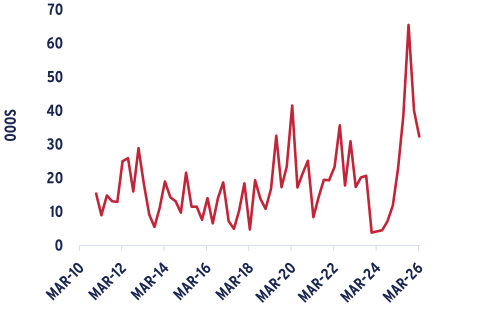
The parallels between 2024 and 2025 are hard to ignore. Last year, tariff escalation froze deal activity across the region; this year, the closure of the Strait of Hormuz have once again reset investor sentiment and increased caution. The macro shock changes may be different, but the effect on investor sentiment is remarkably consistent. For long-term real estate investors, the lesson may be less about predicting when the uncertainty resolves but more about building the conviction to look through it - because the evidence increasingly suggests that these shocks are not anomalies, but a recurring feature of the investment landscape.
ASIA PACIFIC UNCERTAINTY INDEX 2010 TO Q1 2026
*counts how frequently the word "uncertainty" appears in the Economist Intelligence Unit (EIU) quarterly country reports, scaled by total word count
Source: AEW Research, MSCI, Bloomberg, April 2026
Risks Reset and Interest Rates Rise
Growth Forecast For Near-Term Revised Lower
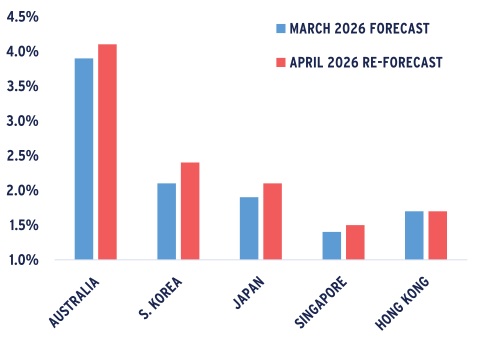
IMF cut its 2026 global growth forecast to 3.1% from 3.3% year-on-year (y-o-y), but more telling perhaps is the structure of the outlook: the traditional baseline has been replaced by a "reference forecast" flanked by two downside scenarios and no upside case – a clear signal of how risks are weighted. Across Asia Pacific, growth forecasts also have been revised lower across some markets for 2026 and 2027, but not all. Still, input cost pressures are likely to remain elevated for longer, reflecting a sustained geopolitical risk premium on commodities and slow supply-side restarts even if this all resolves by H1 2026. The net effect is stickier inflation, and for real estate, this means an outsized impact on development and capex-intensive strategies.
INFLATION RE-FORECASTS FOR 2026
Source: WEO Database, Bloomberg, as of April 2026
Confidence Down But Equities Up?
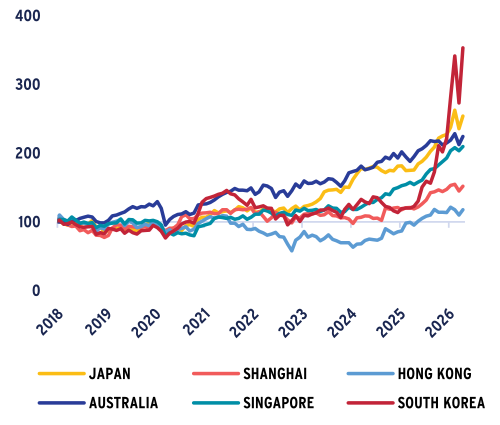
Equity markets remain disconnected from underlying conditions. Indices continue to grind higher on short-lived conflict-resolution optimism and an AI-fueled tech rally. But the broader picture looks very different. Consumer spending is contracting, business investment is getting delayed, and the hiring environment is slowing.
EQUITY MARKET INDICES DEC 2017 TO APRIL 2026
Source: WEO Database, Bloomberg, as of April 2026
Interest Rate Outlook Resets Higher
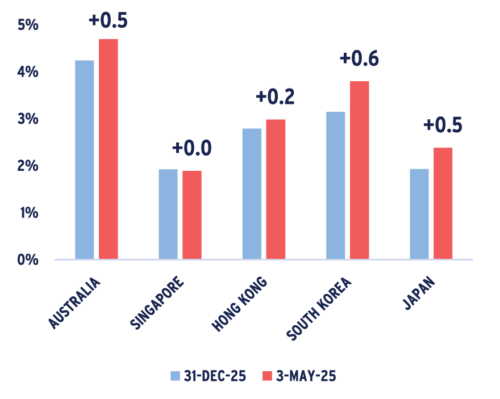
The cost of debt has risen materially across the region, though the degree varies by market. Australia has seen borrowing costs move broadly in line with peers, but the impact on sentiment has been more pronounced given the higher absolute rate level. The Bank of Japan remains characteristically cautious but has signaled that further hikes are on the table, with a move at the June meeting increasingly likely. Singapore tightened monetary policy in mid‑April by allowing its currency to appreciate.
Local Market FX To Be Weighed Down As Long As Uncertainty Remains
Currency weakness lingers as a headwind across Asia Pacific in 2026. In a risk-off environment, the US dollar retains its safe haven status, putting depreciation pressure on regional currencies. Australia could be a notable exception, as the RBA has hiked while the Fed holds steady – however this may fade if the RBA signals a slower pace of hikes ahead.
Within the region, the Singapore dollar and the Chinese yuan have been relative outperformers. The yuan operates within a managed band set by authorities, limiting its volatility by design. The Singapore dollar, while similarly actively managed by the MAS, has also benefited from sustained capital inflows in recent years, reflecting Singapore's broader safe haven appeal in periods of heightened uncertainty.
5Y VS 3M SWAP RATES
Source: WEO Database, Bloomberg, as of 3 May 2026
Short-Term Conditions Are Being Tested, But Holding
LIVING & LODGING
Local Market Pain Points Reinforce Rental Housing Need
We believe that the living sector remains a high conviction theme. Demand is structural, non‑discretionary and largely insulated from the current macro shock. Asian cities continue to attract skilled workers, migrant labor and international students, with changing lifestyle and mobility patterns reinforcing demand for alternative living formats. Each market carries its own structural inefficiencies:
- Australia: acute housing shortage, but construction economics remain unviable at current cost levels.
- Japan: rigid lease structures (key money, guarantor requirements) lock out segments of the renter pool.
- South Korea: the legacy Jeonse system is falling out of favor, particularly among younger renters.
- Singapore: limited short‑tenure rental options leave transitional housing demand unmet.
Addressing these inefficiencies is central to the opportunity. However, most strategies require development risk or significant capital expenditure, and return profiles may shift in today's cost‑push inflationary environment.
INDUSTRIAL & LOGISTICS
Next Rental Growth Cycle Building On A Depleted Pipeline
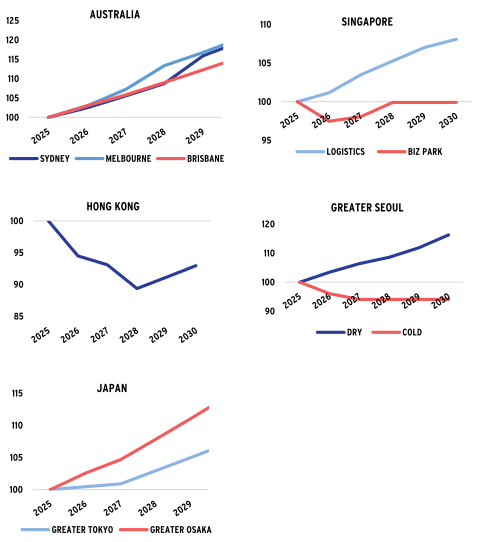
Occupier demand held up broadly in Q1, but decision timelines are extending and cost overruns on a thin‑margin business could weigh on activity if the Iran crisis is protracted. Across Asia Pacific, occupier cycles had been diverging, but project delays and cancellations as a result of rising costs could pull rent cycles back into alignment. The shift is particularly evident in Australia, where supply was expected to peak in 2026/27 but delivery constraints are pushing new completions out, and supporting firmer rental growth.
New supply will not restart until rents rise to meet replacement costs, a process that historically takes two to three years from peak delivery. A limited forward pipeline is laying the groundwork for the next rental growth cycle across Australia, Japan, South Korea and Singapore. Investment volumes are up close to 30% year-on-year, concentrated in Japan and Singapore. Notably, Australia accounted for its smallest share of industrial transactions since 2018 as higher interest rates widened bid‑ask spreads.
OFFICE
Positive Sentiment Concentrated In Few Key Markets
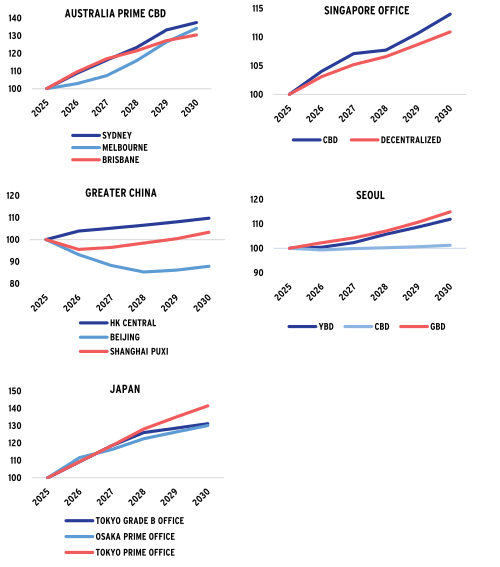
Office market conviction remains concentrated in a handful of markets and increasingly in Prime CBD assets. Sydney, Brisbane, and Japan is expected to lead on income growth, with rent reversion potential of 15% to 20%. Singapore stands apart for its stability as well as solid fundamentals. Beyond Prime CBD in these markets, near‑term appeal is limited. The more pressing medium-term concern is structural rather than cyclical. The impact of AI on white collar employment, and by extension office demand, is an increasingly important variable. White collar employment growth is already slowing to 0.9% p.a. from 2.4% p.a. over the prior decade, and occupiers are beginning to factor this into their long-term space decisions. Despite these headwinds, CBD office recorded its strongest quarter of investment activity in Q1 2026 since 2018, with volumes exceeding US$17 billion, driven by megadeals in Singapore and Tokyo.
RETAIL
Lease Reversion Drives The Investment Case
The sector's investment case today is driven by structural scarcity and lease reversion potential, with passing rents across many assets still below current market levels. Australia and Singapore remain the most actively traded markets, with investor conviction reflected in relatively tight cap rates. The principal risk to monitor is occupancy cost pressure. As rents rise relative to retail sales, occupancy cost ratios are increasing, compressing retailer margins and raising the risk of tenant stress in a period of potentially weakening consumer confidence.
Living & Lodging
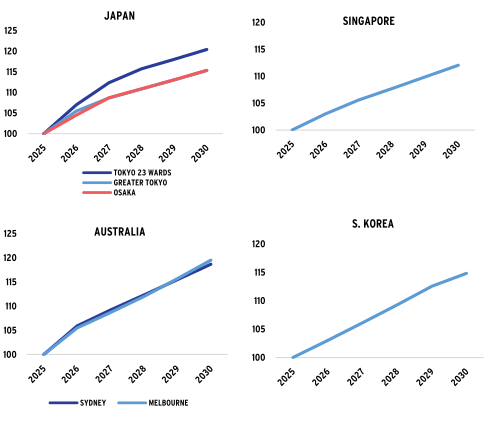
JAPAN: RENT GROWTH OUTLOOK VARIED BY LOCATION
Tokyo multifamily carried strong momentum into Q1 2026 with rents up 6 to 7% y-o-y. In the Central 5 Wards, rent growth is moderating after cumulative gains of 22% in the last three years – yet a persistent gap between market and passing rents still supports income growth. A concurrent but gradual shift from traditional rolling leases to fixed-term contracts is enabling more frequent mark to market repricing opportunity for landlords.
SINGAPORE: LIVING FORMATS CATERING TO FOREIGNERS GROW
Private residential supply is elevated in 2026 (up 33% y-o-y), which is expected to temper growth in the near-term, before reverting to an upward trend. Meanwhile, investor interest in alternative living formats persists, with co-living and serviced residences benefiting from growing cohorts of skilled foreign workers (either project-based or long stay) and international students, up 13% & 47% respectively since 2018.
AUSTRALIA: UNDERSUPPLY TO PERSIST, INTEREST RATES IMPACT PRICES
Construction costs increases (up to 15% expected in 2026) are compounding on an already acute housing supply shortage, while simultaneously building a case for continued upward pressure on rents. Median weekly house rents remain highest in Sydney, a 32% premium to Melbourne today. Rising interest rates on the other hand are beginning to weigh on house prices, which are showing signs of slowing in Sydney and Melbourne, while secondary cities remain resilient. The reforms to the capital gains tax (CGT) discount and negative gearing in May budget should reduce debt-fueled speculation, though neither measure directly addresses the supply gap at the root of Australia's affordability crisis.
HONG KONG: RISING TIDE ACROSS LIVING
Residential markets are starting 2026 on a constructive note - home prices are up 11% since March 2025 and the rental market is up 13% over the same period. This strength is extending into purpose-built student accommodation, which has historically tracked residential rental cycles. For the latter, investor interest is believed to be strong, with hotel-to student accommodation conversions as a preferred entry strategy.
SOUTH KOREA: POLICY STILL TIGHT BUT REVERSAL ON THE CARDS?
Cooling measures have constrained investment activity in South Korea’s living space since Q3 last year. However, a tentative shift emerged in Dec 2025, where single-asset REITs (the predominant vehicle for living assets in South Korea), were granted the ability to defer capital gains tax. This is a modest concession but could be a precursor to broader regulatory loosening, though timing remains uncertain.
LIVING RENT INDEX 2025=100
Source: AEW Research, Oxford Economics, Q1 2026
Logistics
AUSTRALIA: ENTERING A MORE COMPLEX PHASE
Overall vacancy remains low by historical standards at around 3%, but the near-term balance is shifting. For the remainder of 2026, demand is expected to soften faster than supply, tilting conditions in favor of occupiers across a number of submarkets. Beyond 2026, elevated replacement costs should constrain speculative development, limiting new supply and laying the groundwork for the next rental growth cycle as demand stabilizes. Investment activity has retreated substantially in Q1, recording the lowest quarterly transaction volume since Q1 2017.
SINGAPORE: CAPITAL MARKETS COULD OUTPACE OCCUPIER FUNDAMENTALS
Occupiers are likely to move into a wait-and-see mode amid geopolitical tensions and increasing costs. Capital value growth is likely to outpace rental growth over the next year, due to sustained investor demand for quality logistics assets. Business parks continue to be two-speed, with location remaining the key determinant of performance.
HONG KONG: EXPANSION DEMAND STILL MUTED
Despite external trade expanding over 35% in January, leasing activity has remained subdued and vacancy rates continue to increase, reaching 10.5% in Q1, a historical high. We remain cautious on the outlook, given renewed supply chain and cost uncertainty. With yields still fairly compressed at 4.0%, relative to weak fundamentals, the risk of further capital value deterioration remains elevated.
SOUTH KOREA: TIGHTEST SUPPLY IN A DECADE; LOCAL BUYERS RE‑EMERGING
Grade A logistics supply in Greater Seoul will fall to its lowest level in a decade over 2026-27, paving the way for vacancy normalization. Leasing activity held up in Q1 with limited evidence of deferred decisions so far, though it remains to be seen whether this will sustain. Investment sentiment toward the sector is improving, with a notable shift in buyer composition. Last year’s activity was dominated by foreign capital, but local investors are increasingly re‑entering the market, with preferences for prime assets and dry exposure.
JAPAN: INCREMENTALLY POSITIVE, ROBUST DEMAND AND SLOWING SUPPLY
Greater Tokyo's industrial outlook is improving at the margin, with supply delays and cancellations tightening near-term conditions and supporting modest upward revisions to rent forecasts. Still, submarket divergence remains notable, Inland markets such as Ken-O-do face a longer absorption horizon, with excess supply potentially taking up to two years to clear.
LOGISTICS EFFECTIVE RENT INDEX 2025=100
Source: AEW Research, JLL, CBRE as of Q1 2026
Office
AUSTRALIA CBD: SHARP CAPITAL MARKET SHIFT
Sydney and Brisbane CBDs remain standout occupier markets, while Melbourne’s recovery is further curtailed by a new dose of global uncertainty and reforms that could come about from Labour Government’s “Proposed Right to Work from Home”. The sharper shift has been in capital markets - higher interest rate expectations have reset investor pricing, the impact already visible in soft responses to sales campaigns and some processes being pulled.
SINGAPORE: DEFYING REGIONAL TRENDS
Singapore is bucking the regional trend in Q1 2026, with both occupier and investment markets performing strongly. CBD leasing demand has been active, underpinned by a mix of expansions and new set-ups. The investment market has similarly gained momentum, with multiple large core transactions already closed in YTD in 2026.
HONG KONG: MARGINAL IMPROVEMENTS
Positive leasing continued into Q1 2026, though momentum appears to be slowing. Central vacancy has dipped below 10% for the first time in three years, a meaningful improvement, but still far from the 2% to 3% historical norms of 2010 to 2018. Investor interest remains muted, with buyers most likely end users.
CHINA: PROLONGED WEAKNESS IN OCCUPIER AND INVESTMENT MARKETS
Now in its fifth year of structural downturn, occupier markets show signs of stabilizing. Rents seem to be finding a floor, but a meaningful recovery is not yet in view. Liquidity remains thin amid persistent macro headwinds, with the buyer universe largely confined to domestic players comprising state-owned enterprises and high net worth individuals, transacting at substantial discounts.
SOUTH KOREA: SUBMARKETS DIFFERENTIATE, INVESTORS UNDETERRED
The GBD and YBD outlook remains favorable on the back of constrained supply, while the CBD faces a flatter rental profile as 4.8 million sqft of new supply completes by between 2026 and 2029. Still, investment activity remains robust (supported by South Korea’s deep pool of domestic institutional capital) with Q1 2026 volumes up nearly 80% from Q1 2025.
JAPAN: INCOME GROWTH OFFSETS THE RATE DEBATE
Tokyo and Osaka office markets continue to exhibit strong momentum across Grade A and Grade B assets, with supply delays adding a further tailwind to rental growth. Rent reversion potential of 15% to 20% over the next two years keeps the sector firmly on investors radar. Cap rates have yet to move, reflecting broad investor confidence that income growth will absorb any future repricing.
OFFICE EFFECTIVE RENT INDEX 2025=100
Source: AEW Research, JLL, CBRE as of Q1 2026
Retail
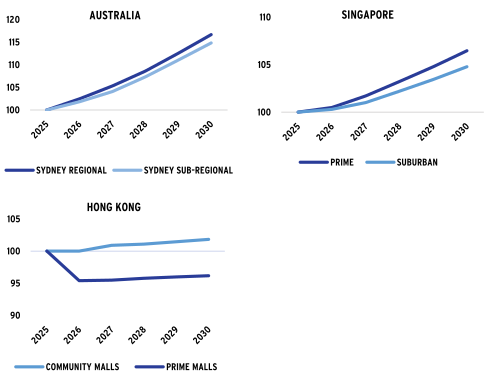
AUSTRALIA: WEAKER HOUSEHOLD INCOME GROWTH WEIGHS ON OUTLOOK
The consumer tailwinds that supported Australian retail through 2025 are fading. Real household income growth is expected to fall to near zero by year-end, pointing to softer consumption ahead. However, the investment case for the sector is less dependent on consumer momentum than on structural undersupply (new supply 70% below historical average), attractive rent reversions (c.6 to 7% p.a.), and compelling entry pricing. Grocery and discount-anchored assets in particular are well positioned to weather a more challenging consumer backdrop.
SINGAPORE: CAPITAL LOOKING THROUGH HEADWINDS
On the occupier side, conditions are softening. Retailers face a combination of higher operational costs, weakening consumer spending amid economic uncertainty, and a potential drag from reduced tourism. The investment picture tells a different story - activity has remained buoyant across asset types, from smaller strata units beneath housing estates to mega malls. Buyers are diverse, spanning institutional investors and high net worth individuals.
HONG KONG: BROAD-BASED RECOVERY ELUSIVE
The 5.5% y-o-y increase in retail sales masks a structurally uneven recovery. Headline growth is disproportionately driven by high-value discretionary purchases, while staples and food retail remain depressed. This is consistent with continued demand displacement toward cross-border shopping, outbound tourism, and e-commerce. Price competitiveness relative to the mainland will remain a key constraint on broad-based recovery.
RETAIL RENT INDEX 2025=100
Source: JLL, AEW Research, as of Q1 2026
For more information, please contact:
HANNA SAFDAR
Head of Research and Strategy, Asia Pacific
hanna.safdar@aew.com
+65.6303.9014
JAY STRUZZIERY, CFA®
Head of Investor Relations
jay.struzziery@aew.com
+1.617.261.9326
This material is intended for information purposes only and does not constitute investment advice or a recommendation. The information and opinions contained in the material have been compiled or arrived at based upon information obtained from sources believed to be reliable, but we do not guarantee its accuracy, completeness or fairness. Opinions expressed reflect prevailing market conditions and are subject to change. Neither this material, nor any of its contents, may be used for any purpose without the consent and knowledge of AEW. There is no assurance that any prediction, projection or forecast will be realized.