
AEW’s European Research & Strategy team present their latest report on European real estate financing, focusing on the narrowing debt funding gap and remaining refinancing challenges amid higher interest rates:
- Higher interest rates are back in focus, as central banks have raised policy rates in response to inflation exceeding targets, amid elevated energy prices linked to the conflict in the Middle East. Swap rates and government bond yields also widened in the wake of political uncertainty surrounding efforts to reduce public deficits.
- Eurozone swap rates rose by 100 bps over the last year. Even with stable loan margins, core Eurozone borrowing costs have increased to 5.1%, in line with average prime European property yields. This implies that debt has become non-accretive again, as it was in 2022-23. However, swap rates did not triple this time, and similarities should be more limited.
- Strong competition between banks has kept loan margins from increasing. But, our loan-level data confirms the swap rate-driven increase in all-in interest rates over the last year. More deliberate and disciplined pricing across LTV bands is increasing, with higher-LTV loans requiring higher margins. This will affect some upcoming high LTV refinancings.
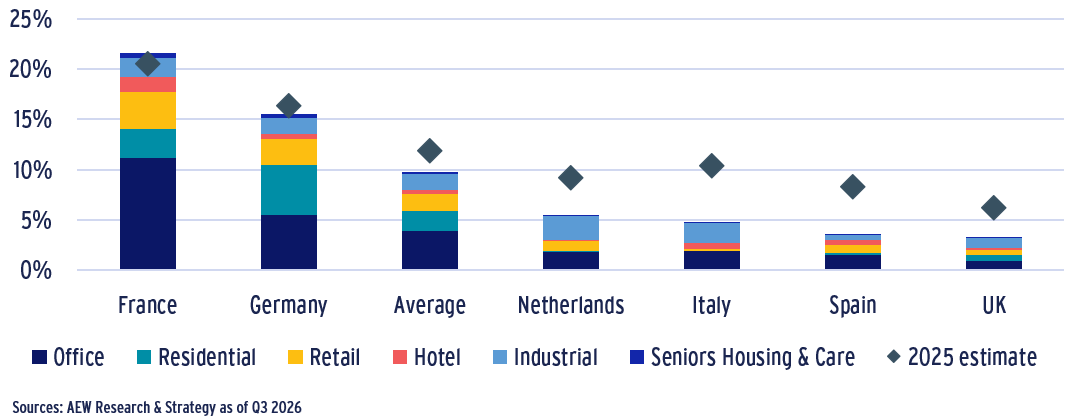
- The remaining refinancing challenges are easing as our 20-country European debt funding gap (DFG) for the next three years is estimated at €45bn – a 50% reduction from 2023. This contraction is also reflected in a reduction of the Europe-wide relative DFG (as a share of past loan originations) from 12% in 2025 for 2026-28 period to 10% for 2027-29.
- The decreasing DFG volume is largely attributable to the eventual refinancing of the most challenged pre-2022 vintage loans. These vintages faced the most severe difficulties, and many were extended with amendments to other terms.
- At 22% of its historical loan originations, France faces the biggest refinancing challenges in Europe. Compared with last year’s estimates, late-cycle France is the only country with an increased share, while Italy and Spain show the biggest improvement. The limited French transparency might be explained by valuation delays and high share of syndication.
- The latest EBA data on commercial real estate loan NPLs shows France below the European average. However, Germany confirms some consistency with our DFG analyses as German banks reported the highest and fastest-growing European NPL ratio. This could be due to valuation delays affecting the NPL ratio data while our DFG is forward looking.
- The DFG is being bridged by: (1) additional equity (2) increased non-bank lending; (3) use of back leverage (or debt-on-debt); (4) significant risk transfer (SRT) trades; and (5) discounted sales of non-performing loan (NPL) positions.
- Debt-on-debt is a widely used collaborative structure to bridge the DFG, with outstanding back leverage estimated at over €50bn in Europe. This implies that it might have bridged over half of our 2023 estimated €90bn DFG already. Even if French and German banks don’t use back leverage themselves, international investment banks might indirectly do so.
- Regardless of their long-term impact on market stability, these bridging solutions have so far avoided painful measures such as NPL portfolio and distressed asset sales. However, tough choices are likely to remain for double extended loans, especially as downward valuation adjustments might not be further postponed and interest rates have stepped up.
Debt funding gap for 2027-29 by country across sectors in % of associated historical loan origination
Please click on the links above to access the full report.
For more information, please contact:
HANS VRENSEN CFA, CRE
Managing Director, Head of Research & Strategy Europe
hans.vrensen@eu.aew.com
This material is intended for information purposes only and does not constitute investment advice or a recommendation. The information and opinions contained in the material have been compiled or arrived at based upon information obtained from sources believed to be reliable, but we do not guarantee its accuracy, completeness or fairness. Opinions expressed reflect prevailing market conditions and are subject to change. Neither this material, nor any of its contents, may be used for any purpose without the consent and knowledge of AEW. There is no assurance that any prediction, projection or forecast will be realized.