
Confronted with a like challenge to distill the secret to sound investment into three words, we venture the motto—margin of safety.
Benjamin Graham The Intelligent Investor
In Searching for Gold, published in March 2025, we made the case that private commercial real estate credit represented one of the most compelling structural opportunities within the private credit universe. Twelve months later, we believe that thesis has only strengthened, as market conditions have evolved in ways that reinforce its relative value.
We write this follow-on not to revisit the argument in favor of real estate credit, but to sharpen it in light of what has changed. U.S. direct lending is now facing what is arguably its most significant stress test ever. We believe it is an appropriate moment to reassess private credit portfolio construction.
Before examining the stress building in corporate direct lending, it is worth stating plainly what differentiates asset-based lending against core real estate from lending against corporate cash flows. At its best, real estate credit is not simply “lending with collateral.” It is lending against a productive, hard asset where downside protection is anchored by (i) replacement cost, (ii) tangible scarcity in supply-constrained markets, and (iii) cash flows that are contractual in nature.
- Replacement cost backstop. A conservative loan basis often sits below what it costs to rebuild the underlying property, potentially providing a structural cushion you may not get when repayment depends on future earnings.
- Real scarcity in top markets. Entitlements, land limits, and community friction can constrain new supply, which may help protect occupancy and rents through a cycle.
- Contractual cash flows. Leases represent legally binding payment obligations with defined terms, which may provide greater predictability than earnings subject to volatility and sponsor-driven capital structure changes common in direct lending.
These attributes do not make real estate credit immune to loss, but they change the starting point for underwriting and, importantly, the path to recovery when things go wrong. Against that backdrop, the mounting test for U.S. direct lending is instructive.
The broad contours of the stress in direct lending are widely reported. What matters now is its scale and what it means for capital preservation. Three realities define the current moment:
- Unprecedented scale confronts this stress. After a decade of rapid growth, U.S. direct lending now represents approximately $644 billion in assets under management, a seven-fold increase over a decade ago, meaning stress in corporate lending will reverberate across the private credit market to a degree that was not possible during the Great Financial Crisis. Much of this growth was invested during a zero interest rate policy environment, during which many argue this rush of capital led to relaxed underwriting standards and covenant deterioration. A change in monetary policy beginning in mid-2022 complicated matters. Since then, higher base rates have compressed borrower interest coverage ratios, leading many borrowers to toggle on payment-in-kind features. In more extreme cases, we have seen liability management exercises to avoid default. Taken together to date, these developments do not suggest a systemic crisis, but they expose vulnerability among higher-risk credits originated in more benign conditions that could lead to repayment challenges in the period ahead.
- Concentration risk means any damage will not be evenly distributed. Software represents one of the highest sector exposures across direct lending, ranging from 21% to 40%+ if affiliated sectors are included. The sector faces structural disruption from artificial intelligence, potentially paralleling the prolonged adjustment experienced by office properties following the work-from-home shift within the real estate market.
- Downside scenarios are building. Defaults have remained at or below historical averages, potentially in part because stress has been deferred through capital structure flexibility and accommodative private markets. If pressure on corporate borrowers continues, whether through geopolitical shocks, higher for longer rates, or a sector-wide revaluation in technology, defaults could rise sharply. Projected default rates vary, but in a stressed scenario, we have seen default forecasts range from 8% (Morgan Stanley) to 15% (UBS). If forecasts of rising defaults are realized, return dispersion within direct lending is likely to widen, rewarding disciplined underwriting and portfolio construction while revealing excess risk taking.
Given the stress evident in the current moment, the next phase of the private credit evolution may be defined less by incremental yield generation and more by downside protection. For investors assessing where that protection resides, the answer returns to where Searching for Gold began. Importantly, real estate credit is confronting this moment from a different point in the cycle which is why we believe it offers a more resilient path ahead, grounded in valuation, fundamentals, and recovery rates.
Valuation
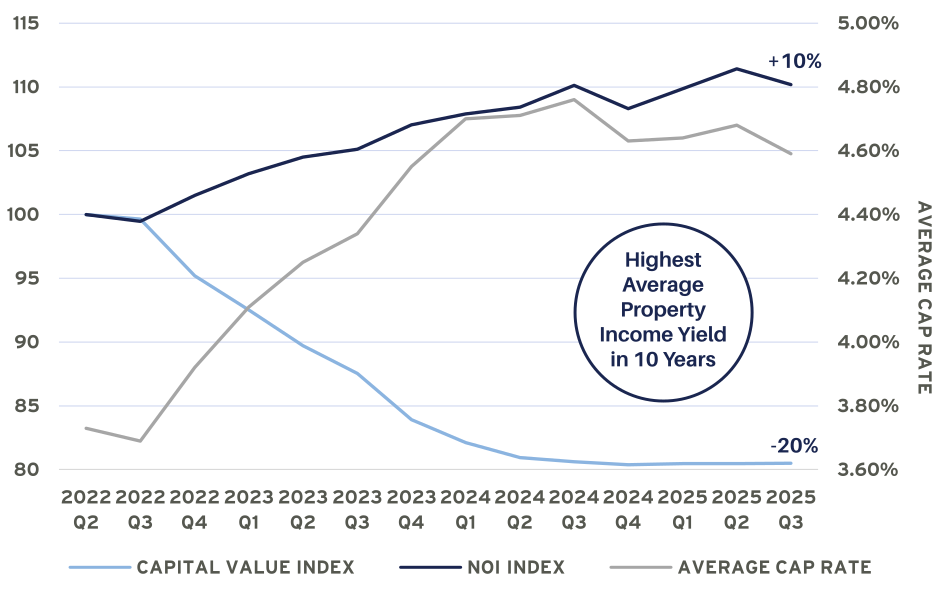
Commercial real estate values repriced meaningfully in response to rising interest rates and have since stabilized, with major real estate indexes reporting modestly positive returns for seven consecutive quarters. Net operating income (cash flow) growth remained broadly positive during this time, rising 10% over a three-year period ending the third quarter of 2025. The index of core real estate properties is now down 20% from its peak, which we believe offers an attractive entry point for new capital, particularly for new originations which have a loan basis at a steep discount to replacement cost.
Figure 1: NPI Capital Value and NOI Indices and Average Cap Rate
Source: NCREIF
Fundamentals
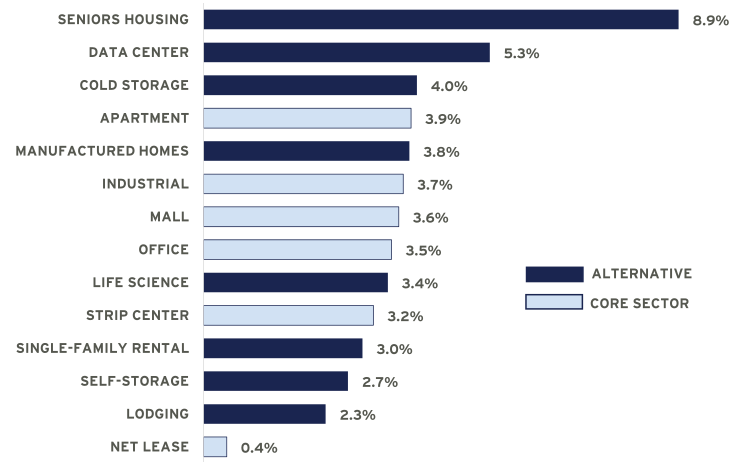
Real estate is generally known for its cash flow durability, but growth is an important factor in its relative value today. Virtually all of U.S. commercial real estate is anticipated to generate future net operating income growth over the next four years, led by alternative sectors such as seniors housing, data centers, and cold storage. However, there is dispersion due to the varied drivers of real estate demand by sector, ranging from healthcare needs (seniors housing), artificial intelligence development (data centers), consumer spending (retail), global trade (industrial), and many more. Real estate offers meaningful diversification within a private credit allocation, with sector-level demand drivers that are largely uncorrelated with the corporate earnings cycle and private equity transaction volumes that drive direct lending performance.
Figure 2: Expected Average Annual Same Store NOI Growth (2028 - 2030)
Source: Green Street
Recovery Rates
All credit strategies are prone to defaults across a market cycle. The critical question is not whether defaults occur, but how much capital is recovered when they do. As discussed earlier, this is where the difference between lending against contractual, hard-asset cash flows and lending against corporate earnings becomes most stark. Recovery rates, however, do not occur automatically. They are a function of both collateral quality and lender control. Club arrangements are a common element of U.S. direct lending. When a club encounters a workout, resolution typically requires coordination across multiple lenders, each with different risk tolerances, hold sizes, and capabilities.
Real estate credit operates differently, with a single lender typically holding the mortgage, meaning decisions are made once, not by committee. We believe that simplicity can be a structural advantage that is often underappreciated in yield comparisons but becomes evident in realized loss outcomes.
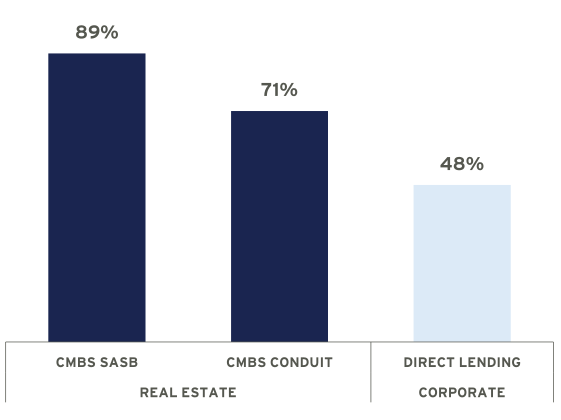
Figure 3: Average Recovery Rate on Defaulted Loans
Source: Cliffwater - 3Q 2025. CMBS Conduit - Q1 2025 study of loans issued between 1995 and Q2 2021. CMBS SASB - Q4 2025 study of SASB loans issued between 1993 and 2024.
In Searching for Gold, we argued that hard collateral and the ability to exhibit control over the collateral during a workout improved recovery outcomes. The data backs up this claim, with KBRA reporting an average loss severity of 28.9% on more than 16,000 resolved loans within conduit CMBS from 1995 through Q1 2024, a period that included multiple severe recessions. A separate KBRA study on SASB (single-asset, single-borrower) CMBS reports an average loss severity of 11.2% across resolved loans, with nearly three-quarters of these defaulted loans experiencing minimal to no loss.
Cliffwater conducted a similar analysis within its Cliffwater Direct Lending Index (CDLI), the industry standard U.S. direct lending benchmark, and concluded the average loss severity on first lien loans was 51.7% post-default. Importantly, this study is over a trailing ten-year period which excludes a full recessionary credit environment, potentially understating loss severity across a complete cycle.
If these historical patterns hold, a real estate credit strategy would need to generate 1.8x to 4.6x more defaults than a first lien direct corporate loan before reaching the same credit loss outcome. In a market where true stress is obscured by payment-in-kind toggles and liability management exercises, this asymmetry is not academic. It is the difference between a portfolio that weathers the cycle and one that does not.
Conclusion
Searching for Gold listed credit quality, diversification, illiquidity premium, and control as key qualities of commercial real estate debt. What has changed over the past 12 months is the sharpness of the relative value case. Real estate credit is entering this period of uncertainty from a position of greater stability: property values have corrected, fundamentals remain positively positioned, and new originations carry a conservative basis relative to replacement cost and prior cycle leverage levels. Direct lending enters this period from the opposite direction.
In this environment, we believe real estate credit is not merely defensive but actively positioned within private credit to deliver durable income with more predictable loss outcomes. The question for investors is no longer whether real estate credit belongs in a private credit allocation but how intentionally it is sized and accessed at today’s basis.
Sources:
https://privatebank.jpmorgan.com/eur/en/insights/markets-and-investing/private-credit-under-the-microscope-separating-headlines-from-fundamentals
https://www.linkedin.com/posts/cliffwater_cdli-privatedebt-directlending-activity-7442203497363800064-xa0F
https://www.kbra.com/publications/ZrLWmSnw/kbra-releases-research-anatomy-of-loss-in-single-borrower-cmbs-a-loan-level-analysis
https://www.kbra.com/publications/wdqmQrBV/kbra-releases-research-conduit-cmbs-default-and-loss-study-update-2-0-begins-to-make-its-mark
For more information, please contact:
JUSTIN PINCKNEY, CFA®
Head of Private Debt
justin.pinckney@aew.com
+1.617.261.9178
This material is intended for information purposes only and does not constitute investment advice or a recommendation. The information and opinions contained in the material have been compiled or arrived at based upon information obtained from sources believed to be reliable, but we do not guarantee its accuracy, completeness or fairness. Opinions expressed reflect prevailing market conditions and are subject to change. Neither this material, nor any of its contents, may be used for any purpose without the consent and knowledge of AEW. There is no assurance that any prediction, projection or forecast will be realized.
CFA® and Chartered Financial Analyst® are registered trademarks owned by the CFA Institute