
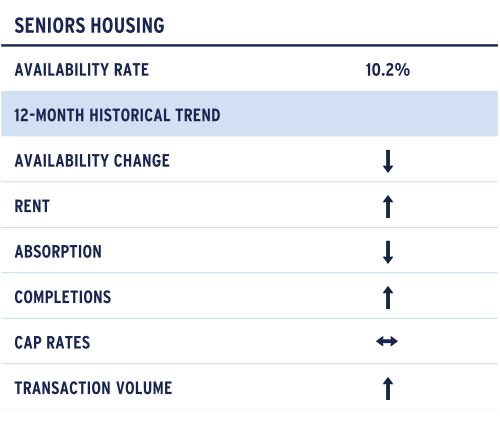
The seniors housing sector continued to deliver solid revenue and NOI growth in the first quarter, building on momentum established over recent years. Resident move‑ins again exceeded move-outs, keeping net absorption above its long‑term average. While absorption was 23% higher than the same period a year earlier, it continued below pre‑pandemic norms, according to data from the National Investment Center for Seniors Housing & Care (NIC)1. This sustained demand highlights the sector’s durability and continuing recovery, reinforced by a limited pace of new development that has supported operator pricing discipline.
Occupancy gains were evident across the sector. NIC‑tracked primary and secondary markets reached 89.8% occupancy in the first quarter, representing a 40‑basis‑point increase from the prior quarter and standing 250 basis points above the pre‑pandemic level of 87.3%2. Both lower‑ and higher-acuity product types contributed to the improvement. Lower‑acuity communities exceeded 91% occupancy, while higher‑acuity properties rose above pre‑COVID levels, surpassing 88%. These results point to broad-based strengthening in demand across care levels.
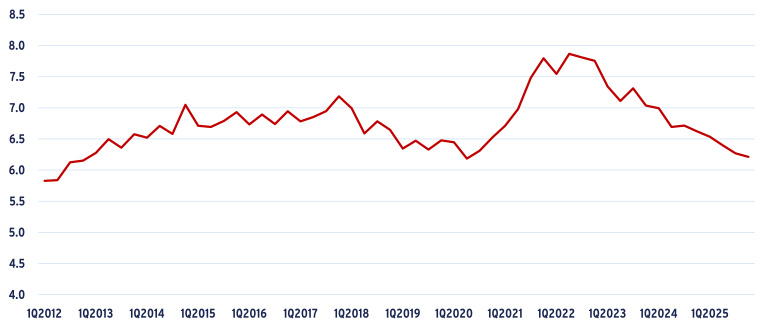
FIGURE 1: MEDIAN EXISTING HOME SALES PRICE/ANNUAL SH RENT
Source: NICMAP, Federal Reserve Bank of St. Louis (FRED)
Rent growth has cooled from inflation‑driven peaks, though operators continue to achieve mid to high single‑digit rate increases. Despite this, the “Years‑of‑Rent” metric for a median home3 continues to move back towards levels last seen in 2012 (6.2 years), down from a peak of 7.9 years in mid‑2022, as rent growth remains above average home price appreciation. Revenue performance continues to meet or exceed budget expectations, and pricing leverage is expected to continue through the remainder of 2026. On the expense side, operating cost pressures have eased, supporting double‑digit NOI growth, though labor is still the most significant cost challenge as operators refine staffing strategies to preserve margins. For its part, seniors housing property in the NCREIF Property Index (NPI) posted year-over-year gains in NOI of more than 20% in the first quarter.
Supply conditions remain constrained. Development starts stay at historically low levels, limited by restricted financing availability and challenging development economics, particularly as many transactions, including stabilized assets, continue to clear at or below replacement cost. Over the past four quarters, construction starts totaled just under 11,000 units, representing approximately 1.0% of existing inventory and only a modest increase from the slowest pace recorded by NIC in mid‑2025. With roughly half of the nation’s seniors housing stock now more than 25 years old, functional obsolescence is increasingly outpacing new supply additions. Currently, only 2.3% of inventory is under construction, while annual absorption stands at 2.8%, well below the post‑pandemic peak near 6%. This ongoing supply‑demand imbalance continues to favor incumbent operators and investors, reinforcing pricing and occupancy fundamentals in the near-term.
Needs‑based demand dynamics continue to distinguish seniors housing as one of the most economically durable segments within commercial real estate. Near‑term pricing power and operating fundamentals are expected to strengthen further, supported by favorable demographic trends. The leading edge of the baby boomer generation is approximately 60% larger than the current resident population, and existing inventory levels and the development pipeline are unlikely to fully accommodate the incoming increase in demand. This demographic shift represents a meaningful long‑term growth driver for the sector that should persist through the near-term.
Capital markets activity remained constructive, supported by improving liquidity and expanding lender participation. First‑quarter transaction volume exceeded $9.6 billion, marking the highest quarterly total of the past decade and surpassing 3Q 2021 (the second-highest quarterly volume) by more than 50%, driven largely by increased acquisition activity from public REITs. While private and institutional investors continued to be active market participants, they were net sellers overall. Rolling four‑quarter transaction volumes reached a ten‑year high, nearly 50% above the prior peak, signaling continued improvement in market liquidity. High‑quality assets in primary markets continued to attract competitive bidding, while weaker properties faced thinner demand or required higher cap rates, though these spreads have started to narrow. Pricing has moved higher on a per‑unit basis, with cap rates generally ranging from the low‑5% to mid‑6% range.
Lenders have maintained a constructive stance toward refinancing opportunities where borrowers can demonstrate a clear forward path, while reengaging in new lending activity at an increasing pace. Agency lenders, including Fannie Mae and Freddie Mac, remain active, and banks have been increasing their participation. Debt fund capital has become more accessible, particularly for value‑add strategies and assets that have not yet reached stabilization. Although credit spreads have tightened, lender risk tolerance remains uneven. Capital availability is deepest for high‑quality, stabilized properties, while construction financing continues to face resistance as many assets transact below replacement cost. Publicly traded REITs continue to access unsecured debt markets at increasingly attractive rates.
In summary, the seniors housing sector has shown signs of strengthening in line with expectations and may present a compelling investment environment, in recent years. Asset values are trending higher, and more accommodating capital‑market conditions are adding liquidity to the transaction landscape. Improving fundamentals, supported by constrained new supply and durable rent growth, are driving revenue gains and supporting double‑digit NOI expansion. While risks related to labor costs, aging inventory, and selective financing constraints persist, the sector’s long‑term outlook is favorable. Demographic tailwinds are especially powerful, with the population entering peak demand years projected to grow by more than 50% in the near-term, providing a sustained runway for growth.
1 Across the primary and secondary markets tracked by NICMAP.
2 As of Q4 2019
3 Median Existing Home Sales Price / Average NIC99 Seniors Housing Rent
For more information, please contact:
MICHAEL ACTON, CFA®
Managing Director, Head of Research & Strategy, North America
michael.acton@aew.com
+1.617.261.9577
JAY STRUZZIERY, CFA®
Head of Investor Relations
jay.struzziery@aew.com
+1.617.261.9326
This material is intended for information purposes only and does not constitute investment advice or a recommendation. The information and opinions contained in the material have been compiled or arrived at based upon information obtained from sources believed to be reliable, but we do not guarantee its accuracy, completeness or fairness. Opinions expressed reflect prevailing market conditions and are subject to change. Neither this material, nor any of its contents, may be used for any purpose without the consent and knowledge of AEW. There is no assurance that any prediction, projection or forecast will be realized.